
热泵热潮下的商业改造:现实挑战不容忽视
热泵作为高效低碳的供暖制冷方案在美国日益普及,但既有商业建筑的改造并非易事。成本高昂、施工干扰大、电网承载能力有限等问题,使得热泵改造面临“冷现实”。本文结合专家访谈与最新数据,剖析热泵改造的物理、经济及电网挑战,并指出热泵需与太阳能、储能等系统协同,方能助力建筑脱碳。
Heat pumps are gaining increasing recognition in many parts of the United States for their energy efficiency advantages and lower greenhouse gas emissions, becoming a focus in the building heating and cooling sector.
The U.S. Climate Alliance, a bipartisan coalition of 25 governors, recently committed to promoting heat pump installations across their states, targeting 20 million units by 2030. According to data from the clean energy think tank RMI, current U.S. heat pump installations stand at approximately 4.8 million units. Progress varies by state: Massachusetts lags behind Maine due to upfront cost concerns and complex equipment selection—Maine has already achieved its 2025 goal of 100,000 heat pumps two years early. Maine's governor, Democrat Janet Mills, recently set a more ambitious new target: 175,000 heat pump installations by 2027.
However, for facility managers looking to deploy heat pumps in existing buildings, despite federal incentives, cost issues and the significant construction and disruption from retrofits remain challenges that cannot be ignored.
Physical Challenges: Space and Piping Constraints
The feasibility of heat pump retrofits in existing buildings varies by building. Ryan Colker, Vice President of Innovation at the International Code Council, said: "Heat pumps are certainly a mature technology, but simply replacing an existing HVAC system with a heat pump system may not be the best strategy."
Kailash Viswanathan, Energy Director at Arch Energy (a subsidiary of Consigli Construction), highlighted two key challenges. The first is building occupancy. He explained that whether such a large-scale renovation can be carried out in a building "depends largely on occupancy. If it's a centralized plan, it's relatively easier to operate, but you still need to enter the building, open walls, and replace piping to achieve it. In most cases, such changes can only be done when tenants move out or leases turn over."
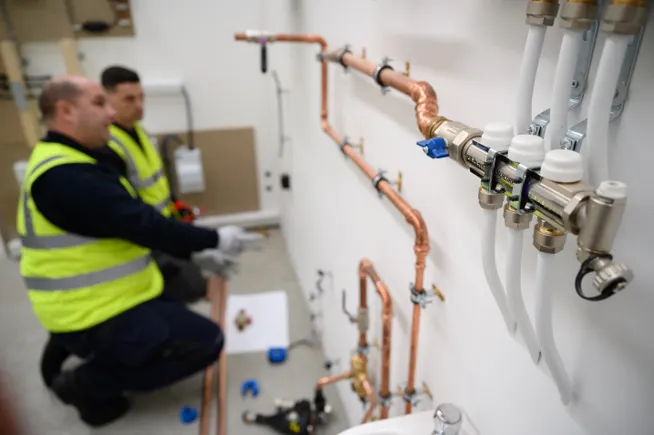
The second is maintaining space heating and hot water temperatures. Viswanathan noted that heat pumps operate most efficiently at lower water temperatures. Retrofitting heat pumps in existing buildings requires reducing water temperature from 180°F to 120–140°F. To achieve the same heating effect at lower water temperatures, larger flow rates are needed, which means increasing pipe diameters. "This requires entering occupied spaces, removing and replacing piping, causing significant disruption," he said. "Therefore, retrofit plans often take 10 to 12 years and cannot be done overnight. For challenging buildings like historic ones, retrofits could take around 20 years."
Viswanathan is involved in a heat pump retrofit project for a high-rise building at 345 Hudson St. in New York City. This is the first project initiated by the New York State Energy Research and Development Authority (NYSERDA) aimed at rapidly electrifying this century-old building. "We help engineers and clients find solutions and determine the best path to reduce the building's carbon emissions," he said.
He added: "Facility managers are always involved in the decision-making process. They consider the challenges of heat pump technology in operation, maintenance, and control. This technology involves a lot of automation, and they need to learn to master it."
Economic Challenges: Retrofit Costs vs. Returns
Another major obstacle is cost. A report by Rosen Consulting Group shows that in 2022, the total cost of retrofitting a typical gas office building in New York State to a ground-source heat pump system was approximately $17–24 per square foot, while air-source heat pumps cost $12–21 per square foot. These estimates include heat pump water heaters, necessary infrastructure, and electrical upgrades.
The report notes that heat pump retrofits in office buildings are expected to yield "significant energy bill savings," but these savings estimates are based on additional building envelope improvements, which will incur extra costs. The Inflation Reduction Act provides federal tax credits and state-managed rebates that can offset some of the costs of purchasing and installing heat pumps.
Doug Davenport, founder and executive director of Prospect Silicon Valley (a nonprofit clean technology accelerator focused on transportation, energy, and infrastructure), said facility managers need a clear understanding of the financial costs and benefits of heat pumps, including long-term maintenance factors, to justify deployment decisions. He also noted that facility managers need more "education and training on aggregating and interpreting actual installation performance results to prove the technology works as reported. This is especially important as a wave of new designs enters the market."
One way to reduce heat pump retrofit costs is to adopt hybrid systems. The National Renewable Energy Laboratory (NREL) reported in September that ground-source heat pumps with hybrid heat exchangers can help building owners and operators reduce capital expenditures and improve the economic viability of retrofit projects. NREL has added capabilities to its REopt tool to analyze such systems, which helps building managers evaluate combinations of renewable energy, conventional energy, storage, and ground-source heat pump technologies to achieve cost, clean energy, and resilience goals.
Grid Challenges: The Importance of Demand Response
Despite the direct benefits of heat pumps for decarbonization, large-scale adoption could put additional strain on local power grids, which may lack sufficient generation capacity to accommodate the expected growth in building electrification. "You can't just install heat pumps without fixing the grid. Everyone is waiting to see if the grid can become green," said Owen Glubiak, Vice President of Revenue at Cortex Sustainability Intelligence.
Cortex recently launched automation features in its building decarbonization platform to help customers reduce energy use and carbon emissions. Glubiak noted that using heat pumps in demand-response-driven scenarios can alleviate grid pressure. "The worst problems occur on the hottest and coldest days. Therefore, demand response programs will become very important to ensure peak demand is met."
Decarbonization Puzzle: Heat Pumps Are Not a Panacea
As Glubiak said, heat pumps are not the whole story of electrification. Thomas A. Kwan, Director of Sustainability Research at Schneider Electric, stated that the benefits of building electrification are maximized when facility managers integrate heat pumps as part of a complete system that includes solar panels and battery storage.
When deciding whether a heat pump retrofit project is economically justified, ICC's Colker recommends conducting a thorough energy audit to fully understand "where you can get the most return on investment and where you can have the best climate impact."
Mark Grinis, Digital Transformation Leader for EY Americas Real Estate practice, noted that facility managers upgrading decades-old building systems often lean toward more pragmatic decisions. "If something breaks, fix it well. But are we willing to consider very complex retrofits?" he described the typical mindset of facility managers. He also pointed out that the feasibility of heat pump retrofits depends on location, including the ability to attract a broader tenant base and achieve higher economic returns. He added that older buildings might have opportunities to install cool roofs and rooftop solar panels, but "I think heat pumps appear more in new construction."
According to the International Energy Agency (IEA), heat pumps currently meet only about 10% of global building heating demand, far below the deployment levels needed to achieve net-zero emissions by 2050. The IEA calls for stronger policy support and technological innovation to improve efficiency, reduce upfront purchase and installation costs, and remove market barriers to complex retrofits.