
2022年电网经受热浪与创纪录负荷考验,未来路在何方?
2022年,美国电网在极端天气和创纪录需求下避免了大规模停电,但专家指出,气候变化的持续影响要求电网运营商和监管机构加速投资基础设施、需求响应和区域合作,以应对未来更频繁的极端事件。
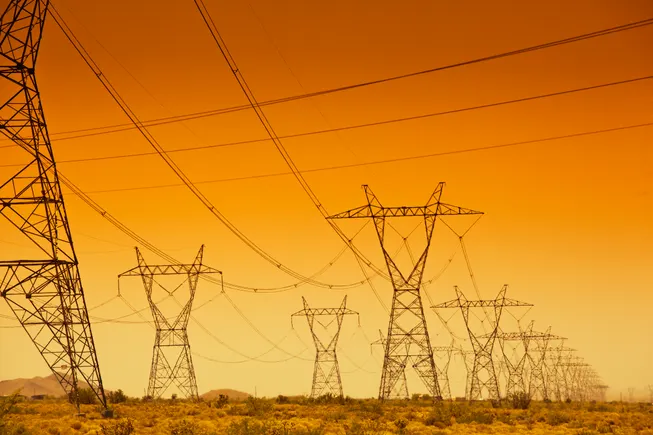
Over the past year, power systems across the United States have faced severe grid reliability challenges, but thanks to a series of policy measures implemented over the past two years and a bit of luck, grid operators have managed to avoid the worst-case scenario of prolonged blackouts, experts say.
Eric Gimon, a senior fellow at Energy Innovation, noted that climate change and extreme weather events—whether heat, cold, storms, or hurricanes—are threatening grid reliability across the United States. He said weather patterns are shifting from historical experience in the U.S. and will continue to become more extreme, "what seems anomalous today will become more common tomorrow. Right now it's a one-way street."
In Texas, the Electric Reliability Council of Texas (ERCOT) grid experienced extreme temperatures and peak loads, but has avoided widespread blackouts so far in 2022; California faced a heat wave in September, and despite extremely tight power supply conditions, also managed to prevent widespread outages. Meanwhile, the Pacific Northwest also experienced high temperatures this year, though not as severe as the 2021 heat wave, and similarly avoided prolonged outages.
Arne Olson, a senior partner at Energy and Environmental Economics, said power system stakeholders are addressing these issues and doing what they can in a relatively short period to prepare the grid for changing weather and demand patterns.
Overall, the grid performed better in 2022 than in the previous two years, and experts attribute this partly to luck—namely, relatively less severe weather conditions—as well as a series of measures implemented by grid operators and planners, such as mobilizing demand response and bringing new battery storage online in California. Olson said, "If they hadn't done these things, we couldn't have gotten through that situation without outages."
However, looking ahead, experts say different regions of the U.S. will need to invest in transmission and other grid infrastructure, build more power resources and demand response capabilities, and cooperate with each other in a more organized manner to ensure they can maintain power supply.
Utility Dive took an in-depth look at three regions facing grid reliability challenges in the U.S.—California, Texas, and the Pacific Northwest—to understand how they performed in 2022 and what the outlook is for 2023 and beyond.
California: '2022 proved the value of changes made'
In September this year, the western U.S. experienced a 10-day heat wave that broke temperature records in the region, including a high of 116 degrees Fahrenheit in downtown Sacramento on September 6. However, the California Independent System Operator (CAISO) did not initiate rotating outages, attributed to increased battery storage on the grid and expanded use of demand response.
Since mid-2020, California has brought about 3.5 gigawatts of storage online, and on September 6—when the grid experienced a record peak load of about 52 gigawatts—conservation calls led to a drop in energy use of about 1.5 gigawatts. The grid operator also pointed to market improvements, such as adjusting resource adequacy assessments, which helped avoid the need for rotating outages.
"Batteries and other capacity resources demonstrated their value, as did coordination with other regions and addressing import and export issues."
—Severin Borenstein, professor at UC Berkeley's Haas School of Business
"I think if you compare to 2020—when CAISO had to initiate outages during another record heat wave—2022 proved the value of the changes and investments made since then," said Severin Borenstein, a professor at UC Berkeley's Haas School of Business and a member of the CAISO Board of Governors.
"Batteries and other capacity resources demonstrated their value, as did coordination with other regions and addressing import and export issues," Borenstein added. "So the good news is it shows we've made a lot of progress—the bad news is we're still very close to rotating outages."
Ben Kujala, senior research lead at Dunsky Energy + Climate Advisors, agreed that the outcome of the western heat wave in 2022 shows that while many reliability improvements are marginal gains relative to past years, "the accumulation of all these small improvements made a huge difference."
After the August 2020 outages, California regulators rolled out a series of demand-side and supply-side measures to strengthen the grid. Borenstein said the state has made progress on the supply side, with the influx of batteries being the best example. At the same time, California still has a lot of work to do in bringing more resources online, especially more storage. In the medium term, the September events reinforced the need to keep existing plants running—whether the 2.2-gigawatt Diablo Canyon nuclear plant or thermal plants—he added, "When we talk about rapidly retiring thermal plants, we have to be aware of how tight the grid is."
On the demand side, California's attitude toward demand response has fundamentally changed over the past few years, said Cisco deVries, CEO of OhmConnect.
"There's no question that demand response has become a key part of the state's response to extreme weather, and there's no question that during this year's Labor Day weekend, demand response saved the day," he added.
On September 6, Pacific Gas and Electric (PG&E) met a record peak demand of 22,672 megawatts, utility spokesperson Paul Doherty said in an email. Since the August 2020 outages, PG&E has added about 1.2 gigawatts of battery storage capacity to its portfolio, and the utility has also procured additional emergency reliability power supplies, he added.
Doherty said the utility also modified and expanded its demand response efforts this summer. More than 1.5 million customers participated in a voluntary program that rewards them for temporarily reducing electricity use during high-demand periods, while other customers participated in its SmartAC program, which cycles air conditioners on and off every 15 minutes for up to 6 hours. Additionally, thousands of PG&E customers with Tesla Powerwall batteries participated in a virtual power plant, discharging to the grid during high-demand periods.
"We met peak load better this summer, partly because a lot of new supply has come online. However, it was Californians and PG&E customers responding to conservation calls during the historic September heat wave that avoided the need for rotating outages," Doherty said.
Pacific Northwest: 'We need to prepare for more heat waves'
In 2021, the Pacific Northwest experienced a heat wave that stressed grid infrastructure and caused outages, which experts said served as a "wake-up call" for the utility sector.
This summer, the region faced high temperatures again, with about 11 million people under excessive heat warnings and another 12 million under heat advisories, according to a July 29 Washington Post report.
Although temperatures this year were far less severe than the 2021 heat wave, another such event occurring so quickly has certainly solidified the notion that temperatures are changing, and "we need to prepare for more heat waves—more frequent heat waves and more extreme heat waves—even in those northern regions that certainly didn't have heat waves in the past," Olson said.
"The past climate is no longer a good guide for the future, so (utilities) really need to start incorporating weather changes into their planning."
—Arne Olson, senior partner at Energy and Environmental Economics
For utilities, this raises at least two issues.
"When they do power planning... they need to forecast changing weather," Olson said. Historically, this meant planning the system around year-to-year weather variability. "But the past climate is no longer a good guide for the future, so they really need to start incorporating changes in weather over time."
Utilities also need to ensure that their guidelines for transmission and distribution infrastructure—such as transmission line sag—reflect the temperatures experienced. The higher the temperature, the greater the sag of power lines, and "high temperatures can really cause damage to distribution system transformers," Olson said.
But addressing these issues itself poses challenges. Kujala said that in building new capacity, the Pacific Northwest faces the same obstacles as other parts of the U.S., such as siting and local opposition. Additionally, project developers across the country face supply chain constraints, critical material shortages, and other delays.
Portland General Electric (PGE) used the 2021 reliability challenges as a learning tool, creating new grid hardening projects, implementing technologies that aid reliability, and adjusting programs in response to changing customer behavior, said Larry Bekkedahl, the utility's senior vice president of energy delivery, in an email. This includes identifying high-risk areas to bury power lines, adding batteries to the system, and installing cameras to more quickly identify and respond to wildfires in its service area.
PGE also offers customers options like peak-time rebates, as well as enabling two-way grid capabilities that support distributed energy resources, Bekkedahl said.
"Looking ahead, we see this as a key area—how to use analytics and smart forecasting to work with customers to create virtual power plants that manage load on the hottest and coldest days. We find many industrial customers are eager to participate in these programs because both sides benefit, but they need advance notice to adjust production, and the smarter our grid and modeling, the easier it is for customers to participate in decarbonization efforts without even thinking about it," he added.
While demand response has shown very positive results in strengthening California's reliability, it tends to be more difficult in the Pacific Northwest because the region relies on a hydroelectric system, Kujala said.
"The conditions requiring demand response each year will vary significantly based on year-to-year changes in hydro generation," he said. Although there are good examples of regional utilities using demand response, "in the Pacific Northwest, the path for demand response is more difficult."
Texas: Focus on thermal units
Texas did not experience a reliability crisis like the one during Winter Storm Uri in 2021, but the ERCOT grid faced very challenging conditions this year—all of the grid's top 10 peak demand events occurred in 2022, hitting a record 80 gigawatts of demand on July 20.
"Texas is still a summer-peaking system, so some of the policies aimed at winter, we'll see how they continue to hold up as we head into the next winter."
—Caitlin Marquis, managing director at Advanced Energy Economy (AEE)
After Winter Storm Uri, Texas regulators began considering a range of market reforms, including new requirements for winterizing generators and expanding the use of distributed energy resources, said Caitlin Marquis, managing director at Advanced Energy Economy (AEE).
Texas regulators are also considering a new market mechanism that would require utilities to purchase performance credits that generators earn based on their availability during periods of high system risk.
"Texas is still a summer-peaking system, so some of the policies aimed at winter, we'll see how they continue to hold up as we head into the next winter," she said. So far, the grid has maintained reliability on peak demand days, but there is still room for improvement in utilizing technologies like distributed energy resources and battery storage, Marquis added.
"To date, the focus has been more on... thermal units and keeping those resources around and functioning," she said.
More broadly, one advantage in Texas is that the region is building a lot of resources, including solar, wind, and batteries, which will improve expected future capacity margins, said Gimon of Energy Innovation.
"The really critical dynamic during the energy transition is how long old resources can hold on while new resources come online. Texas has provided strong incentives for old resources to hold on by adjusting its so-called operating reserve demand curve," he explained, a program that raises power prices when hourly reserves begin to look tight.
What happens next?
Looking ahead to 2023 and beyond, experts generally agree that power systems will continue to face more extreme weather events, and the power industry will need to invest in infrastructure, demand response, and additional power supply resources to handle such events.
On the demand side, regulators need to look more closely at pricing plans that should be better communicated and have stronger incentives to shift demand to the middle of the day, Borenstein said. This may take time, as medium- and long-term adjustments could involve capital investments—"we're talking about automated systems like water heating during off-peak hours to reduce peak demand, heat pump installations, and so on," he explained.
In the short term, states like California need to implement more effective critical peak pricing programs rather than the simpler time-of-use rates that currently exist, Borenstein added, because the peak and off-peak differences are relatively small and don't necessarily reflect the 10 days a year when the grid is in trouble.
Another issue regulators in the West need to address is how California and its neighboring states can cooperate in a more organized way to ensure they can maintain power supply, added Amisha Rai, managing director at AEE. Several western states are increasing their use of renewables and have huge demand for affordable clean energy, meaning policymakers need to study how to use transmission assets in the most efficient way, she said.
This includes "really thinking about how one RTO in the West could better facilitate all that transmission, facilitate renewables across the system, and ensure that no renewables are left behind during times of oversupply..." she added. A July AEE report found that establishing a regional transmission organization covering the West—which policymakers have discussed for over two decades—could bring an additional $79.2 billion in annual regional gross domestic product across 11 states.
Meanwhile, in Texas, regulators earlier this month approved a pilot project allowing aggregation of distributed energy resources to participate in the ERCOT market, aimed at utilizing about 80 megawatts of flexible resources on the grid. The pilot is expected to last three years, and multiple utilities are expected to participate.
Looking ahead over the next few years, a key priority for regulators in the region will be to learn from the first phase of the pilot and expand those lessons to better allow DER participation in the market, said Marquis of AEE.
Another priority will be expanding energy efficiency opportunities, according to Marquis.
"Texas is one of the least energy-efficient states. It also has a very fast-growing residential population, so the potential for efficiency improvements is huge... This is critical to ensuring the state can meet customer demand in both winter and summer," she added.
Then there's the issue of transmission planning, which has become a key priority at the federal level. In July 2021, the Federal Energy Regulatory Commission initiated a process to more closely examine reforming federal transmission policy, which stakeholders say is critical to achieving long-term clean energy goals. Congress is also studying ways to promote new transmission and other infrastructure.
Marquis said addressing transmission infrastructure needs to ensure that new resources like wind, solar, and battery storage can come online in Texas and that generation can reach where it's needed is critical for reliability.
