
ESS Tech launches 1.2 MWh sodium-ion battery 'building block' energy storage system
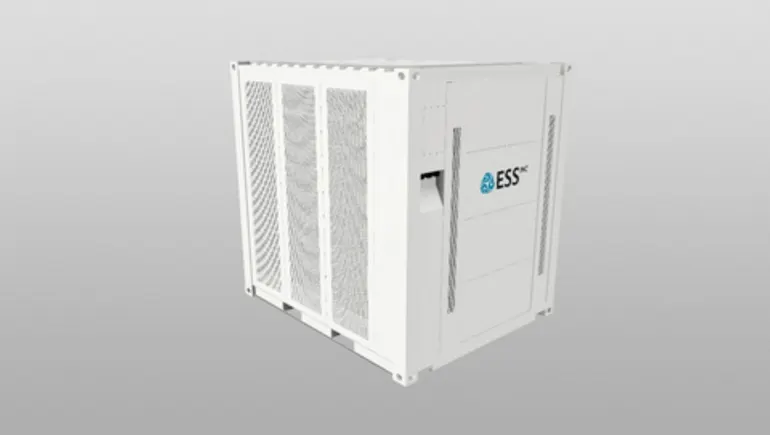
On July 8, ESS Tech announced the launch of a modular sodium-ion battery energy storage system called ESS Bridge, with a single module capacity of 1.2 MWh, stackable to 4.8 MWh in a traditional 20-foot battery container, comparable to the capacity of the latest Tesla Megapack iteration. The company stated that since announcing the procurement of 8.5 GWh of sodium-ion battery cells and modules from Alsym Energy at the end of April, it has attracted over $1 billion in early-stage customer opportunities.
At a Glance
- ESS Tech announced on July 8 that it is launching a 1.2-megawatt-hour "building-block" sodium-ion battery system for utility, commercial and industrial, and data center customers.
- The company said the modular ESS Bridge product can be stacked within a traditional 20-foot battery container to deliver up to 4.8 megawatt-hours of energy, roughly equivalent to the capacity of the latest iteration of Tesla's Megapack, one of the most popular grid-scale energy storage systems on the market.
- ESS Tech's announcement is the latest move in recent months by sodium-ion battery manufacturers and customers seeking alternatives to the lithium-ion chemistry that currently dominates electrochemical energy storage.
In-Depth Analysis
Other recent sodium-ion battery developments come from Peak Energy, based in Colorado. Late last year, Peak said it would deliver up to 4.75 gigawatt-hours of sodium-based batteries to independent power producer Jupiter Power by 2030. In June, Peak announced a manufacturing and design partnership with General Motors to support its stationary storage vision and said it would build a 4-gigawatt-hour sodium-ion energy storage system manufacturing plant in Sacramento, California.
As for ESS Tech itself, the company said it has attracted more than $1 billion in "early-stage customer opportunities" since announcing in late April that it would procure 8.5 gigawatt-hours of sodium-ion battery cells and modules from Alsym Energy.
The announcement marks Oregon-based ESS Tech's entry into the short-duration and medium-duration energy storage market, the company said at the time. Last week, ESS Tech said the ESS Bridge can be configured to provide "16 hours or longer" of continuous discharge.
For the first 15 years after its founding, ESS Tech focused on commercializing iron flow batteries, which the company says can provide 8 to 22 hours of energy capacity and withstand tens of thousands of discharge cycles. However, since going public via a reverse merger in 2021, the company has struggled to gain traction in that market as the number of traditional lithium battery systems deployed by competitors has surged. Its stock price has fallen from nearly $300 per share shortly after listing to less than $1 per share today.
ESS Tech CEO Drew Buckley said in a statement that the ESS Bridge will "meet the demand we are already seeing" from data centers and utilities, while offering an alternative that is "superior" to lithium-ion batteries.
"AI workloads are reshaping energy storage demand at data centers, and sodium-ion technology meets these power needs more effectively than traditional technologies," Buckley said.
Sodium-ion proponents like Buckley say the technology is poised to seize opportunities as utilities and large-load customers seek to secure more capacity on increasingly constrained U.S. power and transmission networks.
Experts say sodium-based batteries are less prone to thermal runaway—a chain reaction triggered by system faults or unsafe operating conditions that can lead to catastrophic fires. One such fire in early 2025 destroyed much of a 300-megawatt Vistra energy storage facility near Santa Cruz, California.
According to the International Energy Agency, this stability allows sodium-ion batteries to operate at virtually any temperature that might occur on Earth's surface. ESS Tech says it also allows for air-cooling systems that consume less energy and require less maintenance than the active liquid-cooling systems typically used to cool lithium batteries, potentially lowering total cost of ownership.
ESS Tech, Peak Energy, and other sodium-ion battery companies say the technology offers another advantage in supply chain certainty—a sharp contrast to the lithium battery supply chain dominated by Chinese companies. ESS Tech says sodium is inexpensive and abundant in North America, reducing geopolitical risks for manufacturers and customers, as well as restrictions on procurement from "foreign entities of concern" under U.S. government rules.
However, sodium-ion battery production and installed capacity still lag far behind lithium battery systems. Additionally, because elemental sodium is more than three times heavier than lithium, sodium-based batteries generally have lower energy density and require a larger footprint to deliver the same energy capacity.