
Massachusetts 'Vehicle-to-Everything' Demonstration Project Reveals Grid Potential of Electric Vehicle Batteries
The Massachusetts Clean Energy Center (MassCEC) is advancing a two-year 'Vehicle-to-Everything' (V2X) demonstration project, deploying bidirectional electric vehicle chargers free of charge to eligible residential, municipal, and school customers. The project aims to assess the potential of electric vehicle batteries for backup power, self-consumption, and demand response. Currently, 4 municipal entities, 5 school districts, and over 45 residents are participating, with an expected installation of 70 to 80 chargers by the end of summer. Early data shows promising prospects for electric school buses in grid support and revenue generation, with some vehicles earning up to $12,000 annually through participation in demand response.
At a Glance
- Massachusetts has begun deploying bidirectional electric vehicle chargers for free to selected customers as part of a two-year "vehicle-to-everything" (V2X) demonstration project, aiming to explore the potential of residential, municipal, and school customers using EV batteries for backup power, self-consumption, and demand response.
- Elijah Sinclair, senior project manager for clean transportation at the Massachusetts Clean Energy Center (MassCEC), the state's economic development agency, told Utility Dive that 70 to 80 chargers should be installed by the end of summer. MassCEC said four municipal entities, five school districts, and more than 45 Massachusetts residents are currently participating.
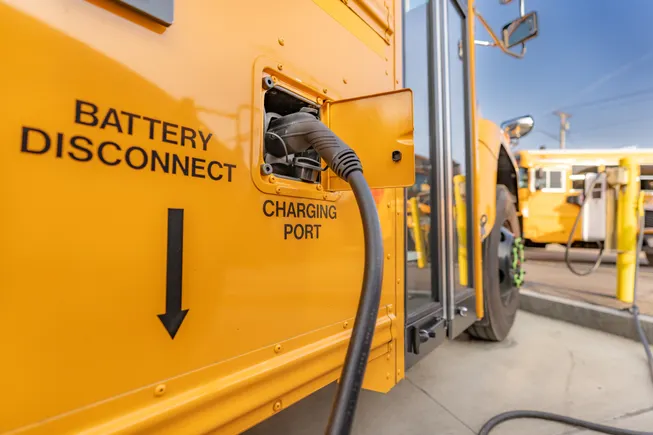
- Sinclair said early results, particularly from Massachusetts school districts, show promise for electric school buses in generating revenue for owners while supporting the state's grid. He said the pilot will help MassCEC, utilities, and other stakeholders understand how school buses and other vehicle models will interact with the grid as EV adoption increases in Massachusetts.
Deep Dive
State- and utility-led bidirectional charging programs, which require specialized charging equipment, are becoming increasingly common across the United States.
Pacific Gas & Electric, a California-based investor-owned utility, offers three bidirectional charging programs. Baltimore Gas & Electric and Sunrun launched a pilot in Maryland two years ago, around the same time the state passed a law requiring utilities to expedite bidirectional charger installations and allow customer vehicles to participate in virtual power plant programs.
Although not all EVs can discharge power, the number of models with this capability is growing. MassCEC said consumer-grade vehicles eligible for the Massachusetts pilot include the Ford F-150 Lightning pickup, Nissan Leaf hatchback, Kia EV9 and Volvo EX90 family SUVs, and the Polestar 3 compact SUV. Five electric school bus models also qualify.
The Massachusetts pilot is one of the EV charging programs selected by the state's Electric Vehicle Infrastructure Coordinating Council (EVICC), which received a portion of a $50 million grant authorized by the American Rescue Plan, a federal stimulus package enacted in 2021.
Sinclair said EVICC's mission is to build the "future EV charging network" in Massachusetts. He said lessons learned from the pilot could help the state overcome persistent challenges to widespread bidirectional charging adoption, such as upfront costs and logistical hurdles.
The goal, Sinclair said, is to validate "how to go from a 'lab experiment' to something anyone can do at home."
Sinclair said the state's ConnectedSolutions virtual power plant is one of the most generous VPPs in the nation for bidirectional EV owners. Certain registered light-duty vehicles could earn around $3,000 per summer.
"That compensation could be very attractive to residential customers," he said.
Sinclair noted that electric school buses, with larger battery capacities and predictable non-operational periods, especially during summer peak demand, could earn substantial revenue annually.
According to a MassCEC case study, buses participating in National Grid's ConnectedSolutions program could earn up to $12,000 per year. In an earlier vehicle-to-grid demonstration during the summers of 2021 and 2022 in Beverly, Massachusetts, a school bus discharged 10.78 MWh to the National Grid system and generated $23,500 in revenue, MassCEC said.
For school buses, "the business case is starting to make sense," Sinclair said, so electric school bus adoption could accelerate in the coming years. He added that the state's utilities, both investor-owned and municipally operated, have taken steps to streamline the interconnection process for bidirectional chargers.
However, utilities are still learning how to manage bidirectional EVs as load management assets. At a workshop hosted by MassCEC last week, Sinclair said at least one utility expressed concerns about balancing "ensuring they get the power they need" with "ensuring vehicle owners can also use their vehicles"—in other words, they worry about drawing too much energy from vehicles during demand response events.
Sinclair is optimistic that utilities will overcome this hurdle. He said EV batteries are much larger than standard residential stationary battery systems, so if scaled to cover a significant portion of Massachusetts' roughly 5 million vehicles, even drawing a small fraction of their stored energy would have a significant impact.