
Market monitoring agency: Data centers push PJM capacity auction costs up by $6.3 billion
The total cost of PJM Interconnection's latest capacity auction reached $16.4 billion, with data center-related costs at $6.3 billion, accounting for 38%. Independent market monitor Monitoring Analytics noted that data center-related costs over the past four auctions totaled $29.4 billion, representing 46% of the total $63.6 billion in costs. The agency recommends separating data centers from the base auction and conducting capacity procurement separately.
Key Takeaways
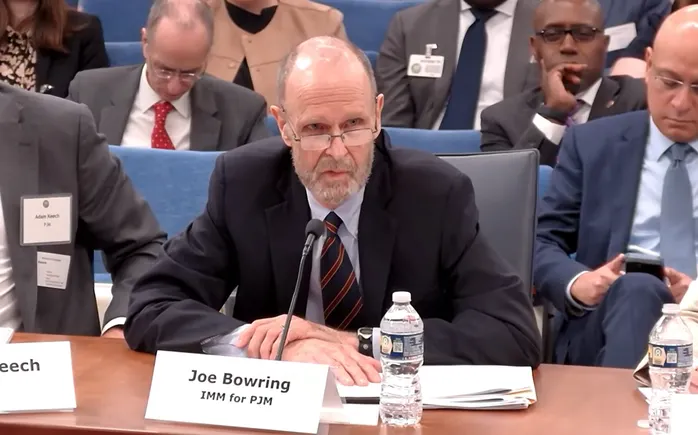
- Data centers incurred $6.3 billion in costs in PJM Interconnection's latest capacity auction, accounting for 38% of the $16.4 billion total, Joseph Bowring, president of Monitoring Analytics, told Utility Dive via email. Monitoring Analytics is PJM's independent market monitor.
- Bowring said that across PJM's last four base capacity auctions, data center-driven capacity costs totaled $29.4 billion, representing 46% of the $63.6 billion total over that period. Monitoring Analytics plans to release its analysis of the latest auction within weeks.
- Bowring believes PJM has not adequately addressed the impact of data center growth. "PJM is still operating in a business-as-usual mode," he said in an interview last Friday. "It has to recognize this is a paradigm shift, or it will shift costs onto other customers."
Deep Dive
According to Bowring, ratepayers in PJM's footprint not only bear capacity costs for existing and prospective data centers but also pay for higher energy and transmission costs driven by data centers.
PJM's capacity auctions and electricity prices have become a major political issue across the grid operator's footprint, which includes 13 Mid-Atlantic and Midwestern states plus the District of Columbia. In September 2025, governors of PJM states formed a collaborative mechanism to protect their interests.
On March 4, 2026, Google, Meta, Microsoft, and other data center companies committed at the White House to protect consumers from electricity price increases caused by data center energy and infrastructure demands.
However, Bowring noted that under PJM's current rules, this commitment cannot be fulfilled.
"The only way to achieve what the hyperscalers agree is the right thing to do is to hold separate auctions," Bowring said. "That benefits hyperscalers because it ensures they get capacity and reliable power; it benefits other customers because it separates out the impact of data centers."
First, under a proposal submitted last month by the market monitor as part of PJM's fast-track stakeholder process for backup reliability auctions, data centers and other large loads should contract for their own generation. For loads that cannot bring their own generation, PJM should hold separate auctions to procure their capacity supply with 15-year contracts.
PJM typically purchases capacity three years in advance based on demand forecasts. However, the actual scale of data center load growth remains uncertain, adding to forecasting uncertainty.
Although PJM has tried to improve data center forecast accuracy, Morningstar DBRS noted in a report released Monday that opposition to data centers is growing across the United States, and some large projects have been canceled.
"As states consider new taxes, restrictions, and moratoriums on data center growth, escalating stakeholder opposition could become a material credit factor, weakening the credit quality of data center projects by reducing development visibility, increasing regulatory risk, and challenging assumptions about the speed and certainty of AI-driven capacity expansion," the credit rating agency said.
Under Monitoring Analytics' auction proposal, removing data centers and the uncertainty of their future load from the base capacity auction would ensure ratepayers do not pay for excess capacity.
The PJM board is developing a backup auction proposal for data centers and plans to submit it to the Federal Energy Regulatory Commission this month, so the auction can be held in September.
Under the proposal that received the most support in the stakeholder process, utilities and other load-serving entities—and possibly data centers themselves—would require PJM to procure specific capacity in a one-time auction. PJM staff proposed procuring the shortfall from the last base capacity auction—about 6.8 GW—in a one-time auction.