
Electric vehicle sales rise, why do automakers still feel anxious?
Although U.S. electric vehicle sales hit a record high in the third quarter of 2023, automakers such as General Motors and Ford are adjusting production plans due to slowing growth, price wars, and profit pressures. Industry experts believe that market concerns may be exaggerated, but the challenges facing automakers are indeed complex.
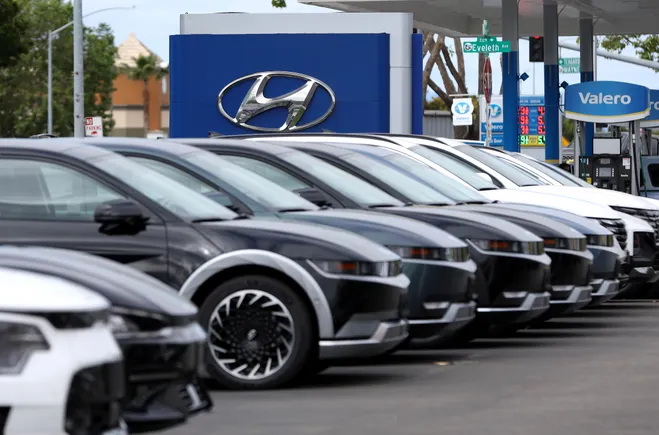
Recently, automakers such as General Motors and Ford have announced scaling back their plans for all-electric vehicles, sparking media concerns about a slowdown in EV sales. However, some experts believe these concerns may be overstated—EV sales are still growing and inventory is declining, but the situation facing automakers is indeed not optimistic.
"The third-quarter sales were actually not bad," said Stephanie Brinley, principal automotive analyst for the Auto Intelligence service at S&P Global Mobility.
According to estimates from Kelley Blue Book, U.S. EV sales reached a record 313,086 units in the third quarter of 2023, a year-over-year increase of 49.8%. This marked the first time quarterly U.S. EV sales surpassed 300,000 units, bringing cumulative sales for the first nine months to over 873,000 units. It is almost certain that annual U.S. sales will exceed 1 million units for the first time, possibly even before Thanksgiving. Cox data shows that U.S. EV sales have grown for 13 consecutive quarters.
Over the past few weeks, third-quarter earnings reports from automakers like GM and Ford also showed relatively strong EV sales. Notably, Stellantis did not disclose specific third-quarter EV sales figures but stated that sales increased 37% year-over-year. Although Hyundai Motor Group did not separately report EV sales, its total sales of hybrids, plug-in hybrids, and EVs in the third quarter approached 169,000 units.

Why automakers are concerned
Despite record-high EV sales in the third quarter and expectations of continued record-breaking, automakers worry that the pace of adoption among new car buyers is slowing—EV market share increased only 0.7% from the second quarter to the third quarter.
"Market share didn't jump the way it did last year," Brinley said. She noted that EV sales are still growing, but not at the "frenzied pace" suggested by sales data from 2022 and early 2023, despite lower prices, more available models, and ample inventory.
"The slowdown in EV demand growth is a topic everyone has been discussing," GM Chief Financial Officer Paul Jacobson said during last month's earnings call.
With Tesla cutting prices by 25% year-over-year, Cox data shows that the average EV price fell to $50,683 in September, well below the over $65,000 price a year earlier. EV incentives accounted for 9.8% of the average transaction price, close to $5,000. Brinley believes that automakers worry that lower prices will make it harder to profit from EV sales, "and that seems to be the root of many (concerns about EV sales)."
High raw material costs are also squeezing automakers' profit margins. According to an analysis by AlixPartners, the dedicated raw material cost per all-electric vehicle for U.S. automakers is about $4,500, which is 38% lower than in 2022 but still double the level in 2020.
"If you rush into things without knowing where the profit will come from... it's unlikely to magically appear later."

Stephanie Brinley
Principal automotive analyst for the Auto Intelligence service at S&P Global Mobility
Take General Motors as an example; the company still faces difficulties in making EVs profitable. GM Chair and CEO Mary Barra said in a letter to shareholders: "Clearly, given the industry's changing price and demand outlook and higher labor costs, we must work hard to achieve our low- to mid-single-digit EBIT margin target for EVs by 2025 and an 8-10% EBIT margin in North America."
The price decline is partly due to increased competition in the EV market. Cox data shows that in the third quarter of 2023, the number of EV models in the U.S. market increased by 14 compared to a year earlier, and inventory days reached 97 days in early October, after peaking at 111 days in early July. This is a significant increase from about 52 days earlier this year (for both internal combustion engine vehicles and EVs). ICE vehicle inventory continues to hover between 52 and 58 days, slightly below the industry's ideal 60-day supply.
The combination of slowing growth, falling prices, and rising inventory has unsettled automakers, prompting some to adjust their EV plans to improve financial conditions. Last month, GM abandoned its plan to produce 400,000 EVs from 2022 to mid-2024 and delayed the production launch of electric trucks, including the Chevrolet Silverado EV and GMC Sierra EV. The company also withdrew from a $5 billion plan with Honda to develop affordable EVs in North America.
During the October earnings call, Barra said the Detroit automaker "is taking immediate steps to improve the profitability of its EV portfolio and adapt to the recent slowdown in growth." Ford also delayed about $12 billion in EV manufacturing investments, including pausing construction of its $3.5 billion EV battery plant in Marshall, Michigan.
"We remain bullish on Model e and our EV future, but clearly the market is a... moving target," Ford CEO Jim Farley said during the October earnings call. Meanwhile, Volkswagen Group abandoned plans to build a $2.1 billion EV plant in Germany.
Experts say automakers should expect EV sales growth to slow compared to the past few years, especially now that ICE vehicle inventory has recovered, providing new car buyers with plenty of viable alternatives. Stephanie Valdez-Streaty, director of industry insights at Cox Automotive, said that the slowdown in EV adoption may be inevitable. Early adopters were less sensitive to issues such as high prices, limited infrastructure, shorter range, and longer charging times.

EV prices remain too high for consumers
A survey released Wednesday by S&P Global Mobility shows that high prices are the main reason new car buyers do not consider EVs, with nearly half (48%) of 7,500 surveyed consumers worldwide saying EVs are too expensive.
"The luxury car market is saturated."
Yen Chen
Chief economist at the Center for Automotive Research
Yen Chen, chief economist at the Center for Automotive Research, said that as the auto industry encounters issues with second and third waves of adopters, lowering prices could further drive EV adoption. In the past few years, EVs have become more price-competitive compared to ICE vehicles, especially in the luxury car market, where new car prices surged about 30%. But this is changing as ICE vehicle production accelerates and logistics bottlenecks fade. Even with prices falling significantly since last year, most EVs are still priced like luxury cars, and many consumers cannot afford them. Chen said automakers need to offer more EVs at "mainstream" prices to accelerate adoption. "The luxury car market is saturated," Chen said.
In the U.S., the Biden administration is trying to lower EV prices at the point of sale by allowing new car buyers to transfer the up to $7,500 clean vehicle tax credit from the Inflation Reduction Act to dealers. Currently, consumers have to wait until they file taxes to claim the credit, making it harder to use. However, Biden has not removed the 25% tariff imposed by former President Trump on vehicles made in China. Chen said this helps keep more affordable EVs out of the U.S. market. Reuters reported Wednesday that U.S. lawmakers from both parties want the White House to further raise these tariffs and find ways to prevent Chinese companies from exporting vehicles to the U.S. from Mexico.
Experts say that while lower prices make it harder for automakers to produce EVs profitably, they are crucial for consumer adoption.

How automakers are addressing EV adoption challenges
Valdez-Streaty said automakers can boost EV sales by improving consumer engagement. For example, automakers can better educate dealers on how to alleviate consumer concerns about range, charging infrastructure, maintenance, and how to leverage tax credits and other policies that make EVs more affordable. Additionally, automakers can partner with utility companies, community groups, and other organizations to help educate the public about EV adoption, Valdez-Streaty said.
"Automakers must consider continuously reducing product costs and securing as much pricing power as possible."
Arun Kumar
Partner and managing director at AlixPartners
Arun Kumar, partner and managing director at consulting firm AlixPartners, added that the under-penetration of the mass-market EV segment makes it harder for consumers to understand how switching to an EV will affect their lives, because a smaller proportion of people know EV owners. "Friends and family are important influencers in purchasing EVs compared to ICE vehicles," Kumar said. Automakers can also make it easier for drivers to charge. Consumers have said, "'Don't sell me a car and then leave me to figure out where to charge it,'" Kumar said.
Automakers are starting to listen, with many planning to adopt Tesla's EV plug—the North American Charging Standard—and give more drivers access to Tesla's vast Supercharger network. Automakers, including Mercedes-Benz, are also launching their own EV charging networks and forming charging joint ventures with other automakers.
However, experts say that reducing production and procurement costs may be the most important thing automakers can do to boost EV sales, as it will allow them to sell more vehicles at lower prices. "Automakers must consider continuously reducing product costs and securing as much pricing power as possible," Kumar said. Lowering battery costs would help significantly. According to the U.S. Department of Energy, battery prices fell 89% from 2008 to 2022, from $1,355 per kilowatt-hour to $153. BloombergNEF forecasts that prices could fall below $100 per kilowatt-hour by 2026.
But experts say there are other ways to reduce costs. For example, Tesla reduced assembly costs by mounting seats on the vehicle's battery pack and installing components from the bottom, rather than installing seats through door openings as most automakers do, Kumar said.
Automakers must find a path through the "profit desert"
Nevertheless, experts say automakers will still struggle to produce EVs profitably for some time, and they need to find a business model that works for them in the meantime. Kumar calls it the "profit desert." "You have to cross the desert, or you won't see profits. But at the end of the desert, there is water," Kumar said. "Not everyone can cross the desert."
During Mercedes-Benz's third-quarter earnings call, Harald Wilhelm, board member responsible for finance and controlling and Mercedes-Benz Mobility, called the EV market "a rather brutal space" due to increased competition. But the company has managed to weather the storm thanks to its profitable ICE vehicle sales. "This is precisely where companies transitioning from ICE vehicles to all-electric vehicles have an advantage over pure-play EV companies," Wilhelm added.
Meanwhile, Tesla's U.S. market share has fallen to 50%, while other pure-play EV makers like Lucid struggle to meet production and sales targets. Experts say the transition from ICE vehicles to EVs is complex, and many ups and downs will plague the process. "This is a marathon, not a sprint," Brinley said. She added that automakers are continuously learning how to design, manufacture, and sell EVs more efficiently. For example, GM and Ford said they adjusted their EV plans based on what they learned. This is an experience other automakers can draw on.
"Slowing down and staying cost-effective is better than rushing and pretending you can find margins elsewhere. Because you won't find them," Brinley said. "If you rush into things without knowing where the profit will come from... it's unlikely to magically appear later."