
Microsoft and PowerHouse Hillwood Dispute Data Center Service Agreement
Microsoft and PowerHouse Hillwood have disputes over service agreements for data center projects in Wisconsin and Illinois, respectively, involving key issues such as cost allocation, early termination fees, and monopolistic practices. Relevant documents have been submitted to the U.S. Federal Energy Regulatory Commission.
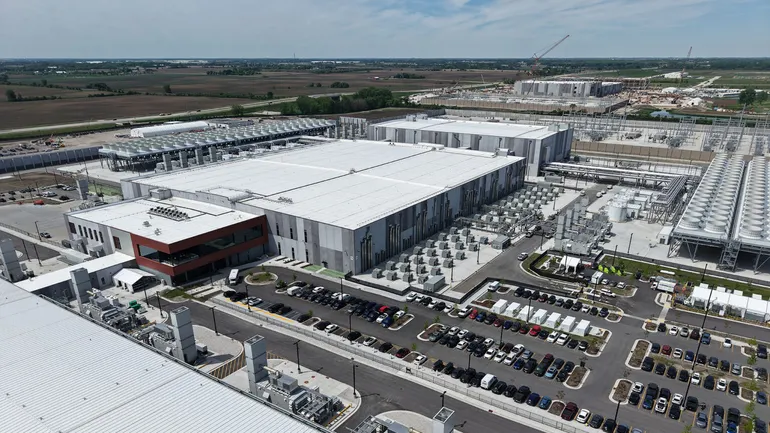
Microsoft and PowerHouse Hillwood Holding are in dispute over the terms and requirements of agreements to serve its planned data centers in Wisconsin and Illinois, with documents filed with the U.S. Federal Energy Regulatory Commission (FERC).
The disagreements come after FERC in mid-June determined that grid operators' large load interconnection rules may be inadequate. In a "show cause" order to grid operators, FERC listed five issues it wants regional transmission organizations (RTOs) and independent system operators (ISOs) to address in large load interconnection rules, including preventing cost shifting and transmission cost transparency. Earlier this month, FERC extended the deadline for RTOs and ISOs to respond to the "show cause" order to mid-November.
Microsoft: Wisconsin Agreement Flawed
Microsoft said in a filing with FERC on Friday that, for example, agreements submitted by American Transmission Co. (ATC) for FERC approval fail to protect utility customers from the cost impact of infrastructure needed to serve Microsoft's data center expansion in Mount Pleasant, Wisconsin.
Microsoft said the four amended Large Load Project Commitment Agreements and Minimum Transmission Charge Agreements were negotiated by affiliates ATC and Wisconsin Electric Power Co. (WEPCo) without consulting Microsoft.
"As a result, the agreements are predictably flawed—containing errors, inconsistencies, and contradictions—and raise several significant cost-of-service and open access issues," Microsoft said.
As a signatory to the White House's Taxpayer Protection Pledge, Microsoft said it is "fully committed" to paying for infrastructure costs associated with its data centers.
Microsoft noted that ATC's proposed Minimum Transmission Charge Agreement lacks mechanisms to prevent WEPCo retail customers from bearing facility costs, and large load customers may face double payment. Additionally, the proposed early termination fee would give ATC an unreasonable windfall, and the transmission company failed to explain why it should be allowed to recover project costs through the "construction work in progress" mechanism.
Microsoft urged FERC to initiate a "settlement judge" procedure to resolve the issue. "Microsoft's participation in the rates, terms, and conditions of these agreements is fundamental to ensuring that the agreements can truly facilitate the timely interconnection and operation of this necessary infrastructure to serve Microsoft's load," Microsoft said.
The Wisconsin Public Service Commission told FERC that ATC's proposed Large Load Project Commitment Agreement is an improvement over past practices but "falls far short of fully responding" to FERC's "show cause" order to MISO, and "additional work is still needed to achieve just and reasonable transmission rates."
ATC and WEPCo argued in filings with FERC that their agreements will protect ratepayers from cost shifting associated with building transmission and distribution infrastructure to serve Microsoft's data center campus. According to ATC, the agreements "directly respond" to FERC's "show cause" order, including concerns about shifting costs to existing customers. ATC owns the transmission system in eastern and central Wisconsin and Michigan's Upper Peninsula.
FERC Asked to Reject ComEd's Cancellation Notice
Meanwhile, PowerHouse Hillwood on August 14 urged FERC to reject Commonwealth Edison's (ComEd) "cancellation notice," which terminated a transmission security agreement related to its planned 1.8-gigawatt, $20 billion data center in Joliet, Illinois.
PowerHouse Hillwood claimed that transmission security agreements developed by Exelon's utility companies, including ComEd, vary and differ from standard form agreements, reflecting utility monopoly power. PowerHouse Hillwood, a joint venture between PowerHouse Data Centers and Hillwood Corp., noted that FERC has rules to avoid anticompetitive utility behavior in generation interconnection, but no similar rules exist for large load interconnection.
"Until transmission service agreements between PJM, eligible customers, and transmission owners include standard form terms and other checks and balances to temper utility anticompetitive and undue discriminatory behavior, the Commission must remain vigilant against the risk of utilities like ComEd using their monopoly power as a coercive tool," PowerHouse Hillwood said.
The company told FERC that the dispute with ComEd, which has led to litigation filed by PowerHouse Hillwood, centers on the timing of collateral payments. According to PowerHouse Hillwood, in addition to asking FERC to cancel the transmission security agreement, ComEd also canceled a retail service agreement pending before the Illinois Commerce Commission.