
Acceleration of U.S. Home Energy Storage: Lessons from Australia's Rooftop Battery Boom
Australian resident Sam's electricity bill showed a credit balance of over 700 Australian dollars (about 500 US dollars), thanks to a flexible energy system comprising rooftop solar, home batteries, and an electric vehicle. Australia has the highest penetration of distributed energy in the world, with 40% of homes equipped with rooftop solar, totaling 28.3 gigawatts of installed capacity, exceeding the nation's coal-fired power capacity; nearly 5% of households have batteries, with over 400,000 new installations between July 2025 and June 2026. In the United States, residential solar coverage is about 9%, and battery installation rates are below 1%, with the main gaps being hardware costs and the lack of pricing mechanisms that value flexibility. Facing a surge in data center electricity demand over the next decade, the United States can learn from Australia's subsidy policies, virtual power plant rules, and rate design to integrate distributed energy into core grid planning.
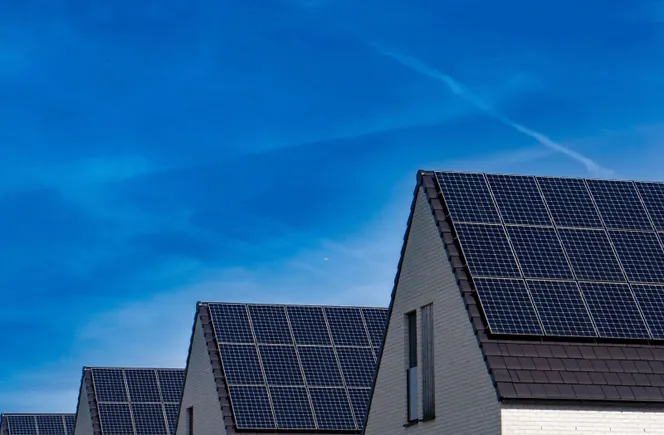
In Australia, a homeowner named Sam recently received an electricity bill and discovered a credit balance of over 700 Australian dollars (about 500 US dollars) accumulated in his account. He installed solar panels, a home battery, and an electric vehicle, and is paid for the flexibility his system provides to the grid.
Stories like Sam's are becoming common in Australia. These cases point to a topic that the US energy industry should study closely as it grapples with surging electricity demand from data centers.
How Australia got here
Australia leads the world in distributed energy adoption: per capita solar installation reaches 990 watts, the highest globally. 40% of homes have rooftop photovoltaics, with total installed capacity of 28.3 gigawatts, exceeding the size of the country's entire coal fleet. Nearly 5% of households have batteries, with over 400,000 new installations added between July 2025 and June 2026 alone.
This achievement stems from two decades of sustained policy push. Rooftop solar incentives began in the early 2000s and evolved into today's Small-scale Renewable Energy Scheme, reducing installation costs by 30% to 40%. In 2025, the federal government launched the 'Cheaper Home Batteries' rebate program, which has since expanded to 7.2 billion Australian dollars (over 5 billion US dollars), targeting 2 million battery installations by 2030. The rebate covers about 30% of battery costs, can be stacked with state incentives, and allows homeowners to earn ongoing income through virtual power plant (VPP) programs.
Why it works
Over the past 20 years, Australia's National Electricity Market has operated with some of the highest and most volatile electricity prices in the world, swinging from negative prices—where customers are paid to consume—to 23.20 Australian dollars per kilowatt-hour (over 16 US dollars per kWh) during supply tightness. Batteries absorb cheap solar power and discharge when prices spike. Since the policy push took effect, solar costs have fallen by over 90% (60% in the last five years), and battery costs have dropped about 50% over a decade. In New South Wales, retail electricity prices fell 10.7% from July 1, 2026, the first decline in five years. Companies like Amber Electric allow customers to trade directly on price volatility, which is how Sam earned his credit balance.
The US situation
About 9% of US homes have rooftop solar, and fewer than 1% have batteries. Hardware costs are a major factor: US solar installation costs about 3 US dollars per watt, while Australia is below 1 US dollar per watt; US battery installation costs about 1000 US dollars per kilowatt-hour, compared to about 500 US dollars in Australia.
Additionally, the US lacks mechanisms to value the flexibility these devices provide. Batteries or smart thermostats that shift load away from peak periods can defer new peaker plants or transmission upgrades, but most US rate structures do not price this in. Addressing this, alongside incentives to lower hardware costs, is the biggest lever to protect Americans from annual electricity price increases exceeding 10% nationally and 15% in some states. Projects like Octopus Energy's Powerstore with Lunar Energy and companies like BASE Power have begun bringing distributed devices into US homes; the question is the speed of scaling.
The data center opportunity
This is an underappreciated breakthrough opportunity for the US. Over the next decade, data center demand will surge sharply, and most utility planning departments default to large centralized builds: gas plants, high-voltage transmission lines, and multi-year interconnection queues.
Australia is addressing data center demand expected to quadruple over the next decade with distributed resources. Local solar and battery systems reduce peak demand and defer infrastructure investments that would otherwise take years to permit. Virtual power plants aggregate this capacity into balancing resources that grid operators can rely on, while paying homeowners directly.
Applying this model to US data centers offers a triple advantage: faster build times than permitting and interconnection queues; local community support through lower electricity bills and enhanced resilience (if hyperscalers help deploy near their sites); and lower-cost grid capacity by using grid infrastructure more intelligently. Matching distributed energy locations with data center loads remains a real challenge, and two-way grids require utilities to rethink their entrenched operating models. Australia is already solving these problems, giving the US a first-mover advantage.
What to do now
Two actions matter most. States should consider battery (and vehicle-to-grid, V2G) incentives modeled on Australia's federal rebate, paired with clear virtual power plant compensation rules so homeowners have a reason to participate. Regulators should push utilities to treat distributed energy flexibility as an established part of rate design and interconnection planning, incorporated from the start rather than as an afterthought.
Australia has proven over two decades that distributed solar and batteries can lower electricity prices, stabilize the grid, and give homeowners a stake in the energy transition. With data center demand arriving now, the US has the opportunity to compress that timeline by treating distributed energy as core infrastructure planning rather than a supplementary program.