
The Battle Over Fast Charging Deployment in the U.S.: Utilities and Charging Companies Vie, Demand Is Urgent but Progress Is Slow
The electrification of U.S. transportation requires large-scale deployment of fast charging stations, but the debate over whether utilities should own and operate charging infrastructure is slowing progress. Analysts on both sides of the issue share this view.
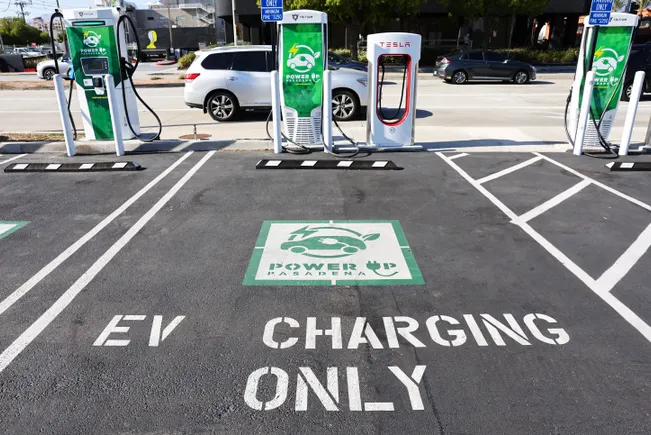
The transition of U.S. transportation to electric vehicles requires large-scale deployment of fast chargers, but the debate over whether utilities should own and operate charging infrastructure is slowing the process, analysts on opposing sides agree.
According to a June 2023 study by the U.S. National Renewable Energy Laboratory (NREL), increasing the share of light-duty zero-emission vehicles, currently about 10% of new car sales, to a national target of 50% by 2030 will require changes that are "unprecedented in the history of the automotive industry." Utilities and charging companies generally agree with NREL's assessment of the enormous need for public charging, but they differ on who should be the primary provider.
Many stakeholders believe that utility investment can accelerate fast charger deployment, especially when regulators allow cost recovery for planned, forward-looking infrastructure development. However, Frank Lacey, founder of Electric Advisors Consulting, points out that utilities recovering the capital costs of chargers through rates means that non-EV owners, including low-income customers, would subsidize higher-income EV owners. Lacey, co-author of a May 2023 paper opposing utility ownership of chargers, said, "These subsidies discourage private sector investment by giving utilities a competitive advantage over other charging providers."
However, Phil Jones, executive director of the Alliance for Transportation Electrification (ATE), responded that new policies, funding, and goals supporting transportation electrification have "changed the rules" for utility spending, making charging costs acceptable to many stakeholders. Jones, co-author of a June 2023 paper advocating for an expanded role for utilities in charger deployment and a former Washington state utility commissioner, added that utility distribution system investment has become a necessary and critical "market enabler" in this transition.
Many stakeholders say fast charger deployment must align with charging utilization to ensure the financial viability of charging infrastructure investments, which requires policy reforms, including forward-looking utility planning and procurement practices. But advocates on both sides of utility ownership of chargers agree that whether utilities should own and operate chargers to meet future demand remains a contentious issue.
Cost Coverage and Intensifying Debate
NREL estimates that the 182,000 public direct current fast charger (DCFC) ports needed to support 33 million EVs by 2030 will cost a cumulative $27 billion to $44 billion. A May 2023 Atlas Public Policy report found that capital commitments from U.S. private investors, governments, and utilities have already exceeded $20 billion. The Inflation Reduction Act of 2022 and the Bipartisan Infrastructure Law of 2021 provide "substantial" further support.
But Cisco DeVries, CEO of distributed energy resource aggregator OhmConnect, says ongoing policy disputes, such as the question of the utility role, "do little good for customers, reliability, or affordability." Autumn Proudlove, deputy director of policy and markets at the North Carolina Clean Energy Technology Center, noted based on the center's Q1 2023 EV policy update report that some recent state policy developments allow utility ownership of charging infrastructure, but more commonly restrict utilities to owning up to the charger or only allow ownership for serving underserved customers. Similarly, legislators and regulators have followed both reasonable arguments for restricting and not restricting utility ownership of charging infrastructure.

Private Market?
Lacey said, "Customers need conveniently deployed and readily available public DCFC sites." His May 2023 paper was funded by the National Association of Convenience Stores. But he noted that the competitive advantage from recovering charger capital costs through rates could lead utilities to build charging facilities in locations that are easier to develop but have lower traffic, which may be inconvenient for drivers. Convenience store owners want to invest in charging stations, but Lacey said competition with "subsidized utilities" could discourage investment and slow the urgently needed expansion of public charging. Restricting the utility role in charging facility ownership can protect utility customers from the costs of charger operation and maintenance, which "can be better performed by charging providers." However, utilities can support charging providers by designing new EV charging rates that limit the impact of demand charges, "especially when charging utilization is too low to significantly threaten peak demand."
Justin Wilson, senior director of utility partnerships and regulatory affairs at ChargePoint, a charging station hardware and software provider, agrees that demand charge reform is necessary. Identifying and implementing new demand charges has already found common ground between utilities and charging providers. Regulators in Utah for Rocky Mountain Power (RMP) and in Arizona for Arizona Public Service (APS) have approved their ownership of public charging facilities, and both utilities say they are implementing new demand charge designs. But Wilson argued that EV charging "should ultimately be done by a private competitive market," and that in the future, most parking spaces will offer fast charging. "The best role for utilities is to complete grid connections as quickly as possible and deploy make-ready distribution system infrastructure." Make-ready refers to the hardware utilities need to build to connect chargers to the grid.
Wilson added, "The private market is good at mobilizing capital to accelerate charger installation." But grid connection is a major obstacle, tying up capital, and regulators should require utilities to accelerate infrastructure upgrades and streamline interconnection processes for policy-priority technologies like EV chargers. Furthermore, Wilson said regulators can accelerate electrification by approving cost recovery for forward-looking system infrastructure procurement by utilities to meet anticipated planned demand.
As the battle over EV charging station ownership continues, utilities are not waiting idly.

Utility Control
Despite opposition from some charging providers, utilities like RMP and APS are partnering with one of the largest private charging providers in the U.S. to enter charger ownership, which some stakeholders see as potential common ground. James Campbell, RMP's director of innovation and sustainability policy, said early projects allowed public charging site owners to choose the charger and maintenance provider, but RMP research found "a pattern of poor maintenance by private providers leading to poor consumer charging experiences." Utah's new RMP-supported H.B.107 law allows utilities to own DCFCs, recover costs, operate, and oversee maintenance. Campbell added that Electrify America subsidiary Electrify Commercial was selected to deploy RMP-owned and branded DCFCs because of its next-generation technology and proven ability to meet high maintenance standards. Tony Perez, APS energy innovation program advisor, said APS also chose Electrify Commercial for a smaller but similar public DCFC program launched in January, for similar reasons.
Campbell said putting the utility brand on chargers makes it necessary to protect system reliability. Non-utility charging facility owners primarily focus on "profit maximization," but system planning enables utilities to deploy efficiently and manage charging load "for the benefit of the system." Aaron Young, senior manager at Electrify America, said its ownership and operation of over 850 DCFC sites and about 4,000 ports at highway and urban, suburban, and rural commercial locations has produced a key insight: "Utilities want to own charging infrastructure, but need expertise or scale to do so cost-effectively, which led to Electrify Commercial." Young said eliminating utility concerns about maintenance services, reliability, and customer experience is crucial because "investment in the U.S. is still far from enough." Electrify America can handle these matters on behalf of utilities, and other charging providers are also exploring this opportunity. Young said, "The California Public Utilities Commission's ruling on forward-looking construction of EV charging infrastructure could also make sense in other states."
Utility advocates say there are other benefits to utility ownership. Kellen Schefter, director of electric transportation at the Edison Electric Institute, said what is "unique" about utility investment is "patient capital," which can invest for the long term and fill "gaps" where third parties do not see a value proposition. Schefter said utilities are "accountable under formal regulatory oversight," and their "track record" of meeting regulatory standards for identifying and addressing reliability challenges is "a skill that will carry over to EV charging infrastructure."
Despite differences, utilities and charging providers are collaborating successfully in states that require it.

Better Together?
As the need for fast charging deployment becomes increasingly apparent, many utilities and private charging builders are finding collaboration is the way to address the challenge. Similar to RMP and APS but without direct utility control, Ford is developing its BlueOval Charge Network, a "network of networks" with about 1,800 DCFCs, with "leading charging providers," said Emma Bergg, Ford's communications director for EVs and BlueOval City. Cameron Freberg, EV and emerging technology strategist at Austin Energy, said the municipal utility recognized in 2011 that "having chargers without vehicles is annoying, but having vehicles without chargers is worse." Freberg said, "Public charging is becoming an expected convenience." But "the most valuable thing utilities can invest in is make-ready, because they are long-term assets," so Austin Energy has shifted its early charging ownership strategy toward building make-ready for private charging providers that commit to its "site host agreement" and allow monitoring of operational performance to ensure reliable charging. He added that utility customers driving EVs are shifting from a "if you build it, they will come" attitude to a "we will go where charging is available" attitude, and they will be unhappy with utilities that do not support charger deployment.
ATE's Jones added that drivers' demand for more and better charging means "all options for utilities to deploy charging infrastructure, including building make-ready and owning and operating chargers with or without charging provider partners, should be decided by state regulators." Jones acknowledged that if private charging provider investment is sufficient, utility grid modernization capital spending or building make-ready may be the best approach for regulated utility markets. Most utilities want to invest in distribution system situational awareness to safely integrate rising EV fast charging levels, but may "prefer to avoid the time and cost of charger maintenance." Chanel Parson, director of electrification at Southern California Edison (SCE), said SCE is an example of this approach, "primarily building make-ready rather than competing with charger owner-operators," while still taking steps to protect customer experience. SCE's approach shows stakeholders with different business models are moving toward the same goal of reliable charging. Parson added that to connect to SCE make-ready, charger owners must contractually commit to operating each port for 10 years and provide monthly operational data reports. These practices are mentioned in utility-owned projects described by RMP's Campbell and as best practices by ChargePoint's Wilson.
Similar to SCE, National Grid New York focuses on "delivering electricity to the charger through make-ready" because it does not want to compete with "an active private market," said Brian Wilkie, National Grid's director of transportation electrification in New York. But Wilkie said a key concern for National Grid is obtaining broader regulatory approval for forward-looking procurement and development of system infrastructure that utility planning and forecasting studies show will be needed as charging load grows. Ken Munson, CEO and president of Rhythmos, a distribution system software provider, agreed that years of underinvestment mean distribution systems need modernization. "But as the EV adoption curve rises, it is outpacing utilities' ability to upgrade assets." Private charging providers like ChargePoint also agree that utilities cannot meet policy-mandated EV growth timelines "if they have to do a distribution system upgrade at 10 MW of new load and then again at 20 MW."
Some stakeholders say the best way to accelerate charging facility deployment may require another factor.
The Time Factor
Despite emerging consensus on demand charge relief, interconnection reform, and new approaches to utility cost recovery, stakeholders say the debate over the utility role in EV charging facility deployment is still missing something. ATE's Jones said, "Utility distribution systems are now the pathway for the value of new technologies like EV charging, and utilities should now be empowered to choose how to optimize that value while protecting reliability." But Lacey said if policymakers do not prevent utilities from leveraging their competitive advantages, charging will be too "economically inefficient" to attract investment, and EV adoption will suffer. Rhythmos's Munson said the charging market is "still forming," and stakeholders are still "learning the best approaches." He added that over time, "utilities have established the environment in which they exist," and the way forward for utilities and private providers "will be an extension of existing value."
Correction:This story has been updated to clarify that Electrify Commercial is not working with regulators or any other party to allow utilities to build EV charging infrastructure and recover costs.