
From Grid Hardening to Grid Intelligence: The Next Era of Wildfire Resilience
As wildfires rage across North America, utilities face scrutiny over early warning and response. The past decade's grid hardening—vegetation management, covered conductors, undergrounding—has hit economic limits. The next era leverages existing sensors and AI to pinpoint risk, enabling surgical shutoffs, risk-based crew deployment, and smarter undergrounding investments, all while complementing physical infrastructure.
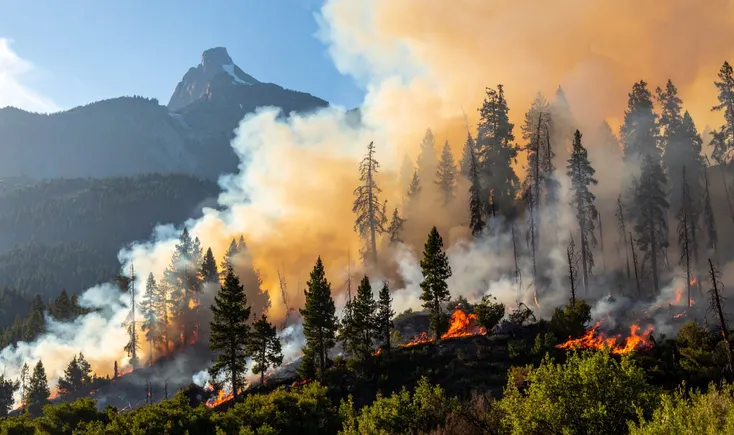
Another summer, another season of evacuation orders and smoke-filled skies across the country, as hundreds of wildfires are burning right now in North America. For the utilities serving those communities, the news footage brings all eyes onto their operations. The big question anyone watching asks is, “What early warning was there before ignition, and did they act on it?”
The last decade of wildfire mitigation was, at its core, a seasonal, multi-year construction project. Vegetation management, covered conductor, sectionalizing devices, undergrounding, and faster-acting protection settings—billions of dollars of physical work went into grid hardening. Largely well spent, these measures made the electric grid harder to ignite. But construction has an economic ceiling, and the industry is approaching it.
Undergrounding costs several million dollars per mile, and no utility can underground its way across a service territory measured in tens of thousands of line miles in a short period. Vegetation cycles consume budget on the same schedule whether a circuit sits in a high-risk canyon or a suburban subdivision. Hardening applied evenly across a territory spends most of its money where the risk isn't. That's why the next era of wildfire resilience will not be built by smarter infrastructure alone.
Wildfire mitigation has turned into a risk-management discipline requiring technologists to work alongside utilities, knowing which mile, which asset, which hour, under which conditions carries the most risk. A utility that knows precisely where its risk sits can retire more of it with a fraction of the capital, and can leave in service what does not need replacing.
The grid is already becoming the sensing network that makes this possible. Metering infrastructure, line sensors, distribution automation, weather networks, and communications systems produce a continuous stream of signal on voltage anomalies, loading patterns, momentary faults, and equipment behavior—conditions that precede failures rather than follow them. A decade ago, a utility learned about a failing asset when it failed. Increasingly, it can learn beforehand, and that brings confidence to customers who pay for reliable, affordable service.
Three shifts when real-time data meets action
Three things change when a utility builds the ability to read what the sensors already say in real-time, and to act on it while it still matters.
Shutoffs become more surgical with smaller impacts
When fire weather turns dangerous, utilities cut power. Today, those shutoffs usually cover whole circuits or districts because operators cannot tell which part of the line is actually the problem. So thousands of people lose power to protect a few miles of line. Some of those people are on oxygen concentrators or well pumps; others are medical baseline recipients or elderly residents trying to stay cool during a heat wave with no air conditioning. Every home left on is a tangible outcome—one regulators already know how to measure.
Crews deployed to acute territory for rapid restoration
Most inspection programs run on a fixed schedule and spend about the same effort on every mile. Pattern recognition changes that. Software trained on years of failure history can compare millions of readings and find the combinations that preceded past failures—a particular voltage signature on a particular class of equipment under particular wind and humidity conditions. No human team can review that volume, but working side by side with a machine, they can continuously. The result is a work list ordered by actual risk, using the same crews and the same budget.
Capital invested in the right miles for undergrounding
Choosing which lines get undergrounded is the biggest wildfire decision most utilities make, and the most expensive. Making that choice from observed asset behavior and modeled risk, rather than territory-wide averages, retires far more risk per dollar than any single piece of equipment. That is the case to bring to a board or a commission.
The criticality of rapid response
Underneath all three is the criticality of fast, rapid response. Because fires start in seconds, analysis in the future must be real-time to enable fast operator decisions to strategically decide, deenergize, and deploy. When the system detects a fault signature on a high-risk line during a red-flag day, the value lies in what happens in the next few seconds. There are protection settings that trip faster, a segment isolated automatically, a crew dispatched before the failure rather than after the fire. None of this replaces physical hardening, but if stronger infrastructure and better information work together, we can take a surgical approach to protecting the grid and our customers from wildfires.