
Lessons from the Rise and Fall of the Previous Natural Gas Construction Boom for the Current Rush to Build
Twenty-five years ago, data center demand drove a boom in U.S. natural gas power plant construction, but after the dot-com bubble burst, demand fell short of expectations, leading to overcapacity. Now, AI electricity demand is again sparking a natural gas investment boom, but analysts point out that U.S. natural gas production, power generation mix, renewable energy development, and the regulatory environment have changed significantly, and investment risks remain.
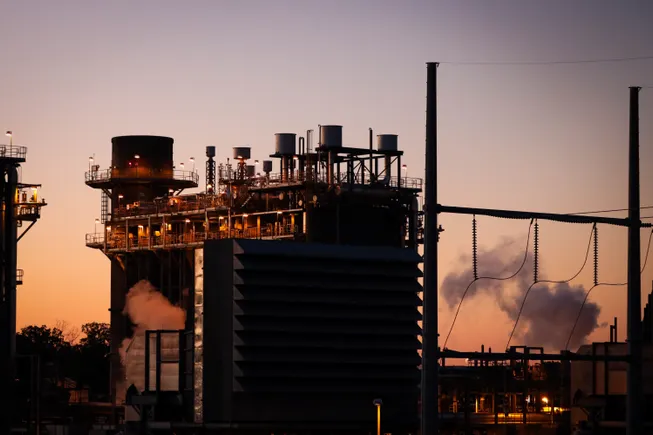
Twenty-five years ago, a wave of natural gas power plant construction driven by data center demand swept across the United States. At the time, the energy secretary, utility companies, politicians, and experts warned of blackouts and economic stagnation if surging electricity demand were not met. However, by 2001, the dot-com bubble burst, the economy fell into recession, and the anticipated surge in demand did not materialize. Rapid gains in energy efficiency and productivity kept electricity demand largely flat for the next two decades, leaving many utilities with excess capacity, the costs of which were ultimately borne by ratepayers.
Today, some analysts and industry figures see parallels with that era. Headlines again warn that AI's electricity demand will lead to energy shortages. Government and industry leaders are pushing for more firm power generation, especially natural gas, framing it as an economic and national security priority.
"Could the same thing happen again? Absolutely," said Eugene Kim, director of Wood Mackenzie's Americas gas research team. "Utilities and everyone doing power demand planning are forecasting unprecedented, sometimes exponential, growth. There is enormous uncertainty about whether that forecast will materialize."
Natural gas investment reaches new heights
Investment firms, utilities, tech giants, energy companies, and others are pouring billions of dollars into acquiring existing natural gas power plants or developing new ones to serve data centers. According to data from energy analytics firm Enverus, valuations for gas-fired power M&A have doubled since 2024, reaching as high as $1.93 million per megawatt in some markets.
Despite the similarities to the turn of the millennium, there are several important differences.
First, U.S. natural gas production and consumption are both at record highs—largely driven by the rise of hydraulic fracturing—with production concentrated in the southern states of Texas and Louisiana, and the northern states of Pennsylvania and West Virginia.
Second, as the U.S. became a natural gas powerhouse, the interdependence between the gas and power sectors deepened significantly. In 2000, the power sector accounted for about 22% of U.S. natural gas consumption, while gas-fired generation provided about 16% of electricity (U.S. Energy Information Administration data). By 2023, the power sector accounted for about 40% of total U.S. natural gas consumption, and gas-fired generation supplied roughly 42% to 43% of utility-scale electricity, making it the largest single fuel source. Over the years, natural gas's role has grown, largely displacing coal, which was phased out due to declining economics.
Third, the large-scale deployment of renewables and storage is another key difference. Although natural gas is the dominant fuel for U.S. power generation, it accounts for a small share of new generating capacity added this year, while storage is capturing a small but growing share of daily peak load after sunset. Utility-scale solar and wind account for 83% of the "high probability" new capacity additions by July 2028 according to the U.S. Federal Energy Regulatory Commission (FERC), with natural gas at about 16%.
There is evidence this landscape could change. Since President Donald Trump took office this year, the outlook for renewables has darkened, as he has largely followed through on pledges to repeal tax credits, permitting, and other government support for wind and solar, while strongly backing fossil fuels.
Enverus energy analyst Scott Wilmot said that before the passage of the One Big Beautiful Bill Act in July, he would have considered the quality and scale of renewable project pipelines sufficient to meet expected energy demand. Now, he is not so sure. "The reality is that without those tax credits, the levelized cost of energy (LCOE) for these renewable projects has gone up," he said. "Many project developers are probably rethinking their pipelines."
PJM Interconnection, the largest U.S. grid operator, is rapidly advancing 11.8 gigawatts of generation projects, most of which are natural gas. Gas also dominates MISO's fast-track interconnection review, accounting for 19 GW of the 26 GW. In ERCOT, natural gas's share of the interconnection queue rose from 6.8% in August 2024 to 9.1% in August 2025. Meanwhile, major natural gas pipeline expansion projects are being planned or proposed.
Amy Andryszak, president and CEO of the Interstate Natural Gas Association of America, said existing pipelines are running at full capacity, and its members report a "record number" of new pipeline inquiries from potential customers. "They say they haven't seen this level of construction interest since the shale boom around 2010 drove pipeline development interest," Andryszak said in an emailed statement. "Many members are already announcing new or restarting pipeline projects, and we expect more members to file certificate applications with FERC over the next 18 months."
FERC is expected to soon issue guidance on colocation rules, which could make it easier to deliver natural gas directly to data centers and other large loads.
The largest natural gas power plant project in the country may be Knighthead Capital Management's 4.5 GW development at the site of the former Homer City coal plant in Pennsylvania, as part of a 3,200-acre data center campus.
Some developers say that even without data centers, electricity demand is rising, and natural gas, as a reliable, dispatchable, and proven energy source, will be a key part of the energy mix for decades to come, especially as more coal plants retire.
Blackstone executive Bilal Khan oversees the firm's recent acquisition of the 620 MW Hill Top Energy Center gas plant in Pennsylvania at roughly $1,600 per kilowatt. The state is in the PJM market, which has set record capacity auction prices, making it attractive to producers. The grid operator attributes this to supply-demand conditions, but its independent market monitor says data centers are the "primary driver" of the price surge. Khan said that even without data centers, he remains bullish on natural gas due to other drivers of electricity demand growth such as manufacturing and electrification. "We still need reliable, firm, and reasonably priced new power supply," Khan said. "This moment is unique, contrasting with the past roughly 20 years of flat electricity demand."
High-stakes investment
However, Khan acknowledged that building new gas plants faces significant hurdles. For example, backlogs for new turbines can stretch up to seven years, with intense global competition for turbines, transformers, and other components. "There are equipment shortages, labor shortages, and it's more difficult to obtain all the necessary permits," Khan said.
The cost of new gas-fired generation is rising rapidly. According to Enverus data, the average capital cost for a new gas plant is $2,200 to $3,000 per kilowatt. GridLab's analysis adds $1,500 per kilowatt for 20-year levelized fuel costs and $500 per kilowatt for pipeline infrastructure, bringing the total cost of new gas-fired generation to $4,000 to $4,500 per kilowatt.
Kevin Smith, CEO of Arevon Energy, who has worked on natural gas, nuclear, and renewable projects before focusing on renewables, said that given prices, pipeline constraints, and interconnection queues, there is a limit to how much gas can be built to meet near-term demand. "Tens of gigawatts of new gas capacity could take at least five years, if not longer," Smith said.
Changing market dynamics also mean new gas-fired units face stricter economic operating conditions, according to a recent Ascend Analytics report on thermal generation. Their competitiveness depends on the type of gas generation technology, varying by efficiency, availability, ramp rates, cold-start costs, and other factors. But overall, Ascend said the value of gas assets will increasingly be concentrated in "narrow, infrequent time windows," raising the importance of availability, fuel supply security, and strategic planned maintenance.
"Given rising electricity demand and declining capacity accreditation for renewables and storage, the need for dispatchable, long-duration capacity resources will persist. To meet this need, new gas capacity will be built," the report concluded. "However, new gas investment should be cautious, prudent, and strategic. Thermal generation will remain a high-risk investment, and the risk of stranded assets has not disappeared."
Have utilities learned the lesson?
Amid rising residential electricity bills, utilities and regulators say they are taking precautions to protect ratepayers from a bubble. Travis Kavulla, vice president of regulatory affairs at NRG Energy, said past experience has shaped current industry practices, where in deregulated markets, competitive generators bear load forecast risk. "All of this affects people's willingness to build generation quickly," he said during a recent panel hosted by The Heritage Foundation. "That's why long-term power purchase agreements are so important in this industry."
Some regulators and utilities are shifting more risk onto hyperscale users by creating new rate classes for large loads. According to a database from the North Carolina Clean Energy Technology Center and the Smart Electric Power Alliance, at least 30 states have proposed or approved large load rates in the past few years to manage growth and protect existing ratepayers.
The Public Utilities Commission of Ohio recently approved a plan by AEP Ohio requiring data centers to pay for at least 85% of their requested electricity capacity, even if they use less, to cover infrastructure costs. The plan also requires data centers to demonstrate financial viability and pay exit fees if projects are canceled or they fail to meet obligations. Since then, the utility said its data center pipeline has shrunk by half—a development Enverus's Wilmot views as positive. "We cannot allow unlimited data center demand growth," he said. "Otherwise, ratepayers will face very serious challenges."
Dominion Energy, which serves the Ashburn, Virginia area—the world's most concentrated data center region—has proposed similar rates. Under its proposal, large load customers would commit to paying for their requested capacity for 14 years, regardless of actual usage. Dominion spokesperson Aaron Ruby said the utility is focused on ensuring residential customers do not subsidize the cost of infrastructure needed by data center customers, and it has not encountered delays in advancing 5.9 GW of new gas generation. He suggested the risk of overbuilding is low, recalling only one data center project falling through in the past 20 years. "Within a year or two, another data center customer came along and fully utilized the infrastructure," he said.
Others are skeptical. Abe Silverman, assistant research scholar at Johns Hopkins University's Ralph O'Connor Sustainable Energy Institute, said it is too early to judge AI's impact on electricity consumption. "This is a baby industry, and we are building and paying for infrastructure today for data centers that don't yet exist," he said. "We are investing based on these very bubbly assumptions to build grid infrastructure."
Wood Mackenzie's Kim believes the power industry has matured since the last bubble burst. At that time, the three major gas turbine manufacturers—GE Vernova, Mitsubishi, and Siemens—"suffered significant losses," he said. "Utilities lost heavily from overbuilding and are now more cautious."
Kim predicts that with or without data centers, gas-fired generation is likely to continue increasing due to coal retirements and electricity demand growth. Advanced manufacturing facilities need more energy; as the climate changes, summers are hotter, increasing cooling demand; and a larger renewable portfolio will require dispatchable generation that storage cannot currently replace. But he said an economic downturn, technological innovation, efficiency gains, and any unforeseen factors could affect this highly speculative growth scenario. "However, since pipelines can take two or four years to build, if you're going to build a power plant and support it, you have to start building those pipelines now," Kim said. "Whether those plants or pipelines will be underutilized because the boom fails to materialize remains to be seen."


