
2026 FERC Outlook: Rising Costs Constrain Regulator's Options in Data Centers, Transmission, and More
In 2026, under pressure from the Trump administration to accelerate data center development, the U.S. Federal Energy Regulatory Commission (FERC) must also address energy affordability and grid reliability challenges, and meet compliance deadlines for new transmission planning and cost allocation rules. This article analyzes key issues and stakeholder perspectives on FERC's handling of large-load grid connections, transmission planning compliance, and electricity market reforms.
The U.S. Federal Energy Regulatory Commission (FERC) faces a severe test in 2026: on one hand, it is under pressure from the Trump administration to accelerate data center development, while on the other, concerns over energy affordability and grid reliability are growing. At the same time, FERC must oversee the approaching compliance deadlines for new rules on transmission planning and cost allocation.
"These two matters will consume a great deal of FERC's energy," said Devin Hartman, director of energy and environmental policy at the free-market-oriented think tank R Street Institute. "Especially at the policy level, it will be difficult to free up capacity to handle other affairs."
The Trump administration's strong focus on data center development comes amid external questions about FERC's status as an independent agency. Two of the five commissioners, the most recent additions—Laura Swett and Lacerte—were both nominated by President Donald Trump, who has also sought to impose new requirements on regulatory agencies through executive orders.
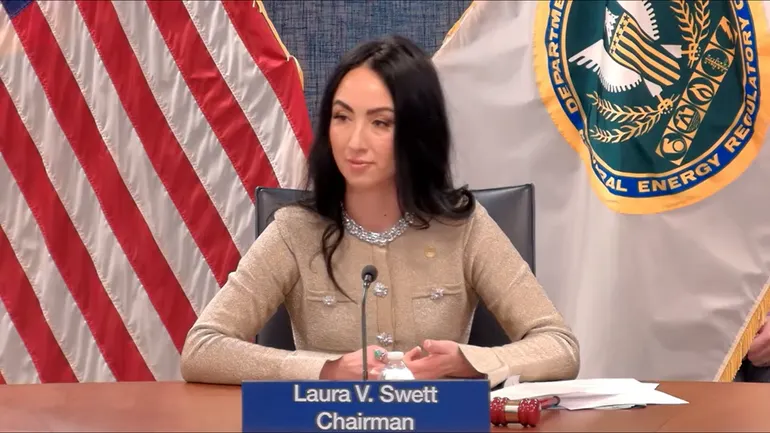
New FERC Chairman Laura Swett echoed the administration's priorities at her first public meeting in November, stating that connecting data centers to the grid is her "top priority," while also balancing the agency's responsibility to ensure the grid operates reliably at fair rates. "I expect Chairman Swett's alignment with White House priorities may exceed that of any chairman in history," Hartman said.
However, former Chairman Willie Phillips (now a partner at the law firm Holland & Knight) expressed confidence in the commissioners' independence. "If you value energy dominance, value reliability, and want FERC to act as an impartial referee, then you must value independence. I believe we have a FERC that does so," he said.
Phillips believes that for Swett and FERC, the core of 2026 lies in ensuring that recent transmission and interconnection reform measures take real effect, that approved projects are built, and that new rules are established for large loads. "In many ways, this year is more about implementation and enforcement than new policy reforms," he said.
DOE co-location proposal dominates early agenda
In the near term, FERC is focusing on the U.S. Department of Energy's (DOE) proposal to connect co-located loads to the transmission system. The proposal, issued in October and targeting data centers, surprised many observers, with some calling it an "unusual move to expand federal authority." FERC responded quickly, seeking comments four days later with a November 14 deadline, which was later extended by two weeks. DOE has asked FERC to issue a final rule by April 30—a deadline the National Association of State Utility Consumer Advocates called "clearly unreasonable."
Public comments on the DOE proposal reflect deep concerns from state lawmakers, regulators, grid operators, and consumer advocates, particularly over the division of federal and state regulatory authority. The National Association of Regulatory Utility Commissioners (NARUC) stated that under the Federal Power Act, states have jurisdiction over the interconnection of retail loads, regardless of size, including "end-use" electricity sales. FERC has never asserted jurisdiction over end-user load interconnection.
"If FERC asserts jurisdiction over a limited category of retail customer service, it would interfere with state regulators' balancing decisions in retail rate cases, which are entirely state-level determinations," said the organization representing state regulators.
Steven Shparber, a member of the law firm Mintz, Levin, Cohn, Ferris, Glovsky and Popeo, believes clarifying the federal-state jurisdictional issue will be an important part of the rulemaking process. "How far FERC can go in asserting jurisdiction over large load interconnection will be interesting. I think FERC will be very careful to ensure any final rule has legal durability."
Karen Bruni, a partner at Steptoe, said she is watching how detailed FERC's response to the DOE proposal will be. "Will it be very clear directives to regional transmission organizations (RTOs) and transmission providers, or higher-level, broader guidance requiring compliance filings and allowing regional flexibility?" she said.
Josh Price, director of the energy team at research firm Capstone, expects FERC to maintain the existing jurisdictional divide to avoid resistance from states and utilities, focusing on matters entirely within federal jurisdiction, such as generation interconnection reform, new demand response products, and capacity markets.
New transmission plan compliance deadlines approach
Meanwhile, FERC will also respond to compliance filings from RTOs and transmission providers regarding its Order No. 1920 on transmission planning and cost allocation. The rule requires grid planners to develop transmission plans with at least a 20-year outlook, use multiple scenarios, and consider grid-enhancing technologies, among other things. It also gives states a more significant role in the cost allocation process—a provision expected to be a major point of contention.
FERC Commissioner Judy Chang warned in January that efforts to bring generation online quickly through improved interconnection processes could be ineffective without adequate transmission planning. "Just because we accelerate the front-end process for generation and load interconnection, without sufficient grid and reliability upgrades, we actually cannot operate," Chang said at a FERC open meeting on January 22.
Most compliance filings for Order No. 1920 are due this year and could be crucial to addressing Chang's concerns. "How thoroughly FERC reviews these filings and requires adjustments to set a high standard for Order 1920 compliance will be very important for the future of transmission planning," said Hartman of R Street.
At the same time, the Fourth Circuit Court of Appeals is hearing appeals from state attorneys general, utility commissions, environmental groups, and others on multiple aspects of Order No. 1920. The rule was issued in May 2024 and revised in November of that year. Several federal agencies under the Trump administration have stopped defending or fully rescinded Biden-era rules, but FERC currently maintains Order No. 1920 and filed its defense brief with the court on January 5.
The brief states that the Commission issued Order No. 1920 to "correct an urgent, widespread, and growing problem—the existing transmission process has failed to produce new transmission infrastructure that meets long-term transmission needs in a cost-effective manner." The result, it says, is an aging grid, with transmission providers updating in a piecemeal, isolated fashion, leading to inefficient and costly transmission investments and rates that fail to meet the 'just and reasonable' standard of the Federal Power Act.
Bruni said it will be interesting to watch how the current Commission handles compliance filings and whether the court orders modifications. "This is definitely worth close attention because it will give Chairman Swett an opportunity," she said.
Soaring power prices may trigger market reforms
Recent surges in electricity demand forecasts and supply tightness in parts of the United States could also lead to changes in the wholesale electricity markets FERC regulates. PJM Interconnection, the nation's largest grid operator, coordinates electricity sales for most of 13 mid-Atlantic states and 67 million people. In its last three base capacity auctions, prices soared to new highs, even though the system did not meet capacity targets.
Former FERC Chairman Mark Christie (who stepped down last year and now serves as director of the Center for Energy Law and Policy at William & Mary Law School) said PJM is "absolutely in a crisis phase, and it will get worse."
Phillips noted that existing wholesale electricity markets were designed for an era of relatively stable demand and more predictable changes in resource mix. System operators are trying to adapt. PJM's board has called for a comprehensive review of its market structure, and ISO New England recently proposed a complete overhaul of its capacity market, shifting from a forward market to "prompt" auctions.
At the direction of PJM's board, its stakeholders have begun considering "reliability backstop" auctions for power supply serving data center loads—potentially the most controversial element of the board's large load interconnection plan. PJM's governance body and the Trump administration also want special auctions for data center loads at PJM.
"We will continue to see opportunities for FERC to adjust market rules nationwide," Phillips said. For example, Hannah Rogers, an analyst on Capstone's energy team, noted that the Trump administration has given clear direction—and FERC seems to agree—to find ways to increase capacity revenues for thermal resources. "We may see FERC or different RTOs, like PJM, take action to evaluate attributes such as fuel security as a way to pick winners and losers or incentivize more thermal generation like natural gas and coal," she said.
Rogers added that changes to capacity accreditation (which measures a resource's contribution to reliability during grid stress) could also be used to favor thermal resources. Grid operators' capacity accreditation frameworks must be approved by FERC. Capstone's Price said that under the banner of affordability, the Trump administration might also attempt to shift costs onto renewable resources through interconnection rules, market structures, and hardening requirements. "I think this strategy will enter FERC policy," he said.
Affordability looms over FERC decisions
FERC's efforts to promote data center development—and the question of how to allocate the billions of dollars in costs of interconnecting new power plants and transmission lines—come amid intense focus on electricity affordability. With the November midterm elections approaching, affordability will be a topic of discussion at all levels of the federal government, Bruni said. "I think that message has been conveyed to FERC," she said. At FERC, the issue may manifest in decisions on transmission project cost allocation and the costs of interconnecting large customers and their power supply projects.
Former Chairman Christie warned that it would be a mistake for FERC to allow existing generation to be "cannibalized" to serve a single customer, such as a data center, which would negatively impact the entire grid and other ratepayers. "The most important issue FERC faces this year is how to respond to the massive load growth from data center development and how to balance the need for new generation to maintain supply," he said. "FERC must ensure that in any RTO rules, especially on co-location, the costs of data center interconnection are not shifted to all other consumers, such as residential and small business customers."
Former Chairman Phillips expressed similar views. "The challenge is ensuring that large loads are interconnected in a transparent, predictable manner that is fair to existing customers," Phillips said. "Of course, we all know cost allocation is where policy and politics intersect—FERC's challenge, as always, is to ensure that beneficiaries pay and to do so in a way that does not harm or discourage much-needed infrastructure investment."


