
California's First Offshore Wind Auction: A Cautious Start with Long-Term Promise
The Bureau of Ocean Energy Management's first offshore wind lease sale in the Pacific Ocean concluded with winning bids totaling $757.1 million across five lease areas off central and northern California. The average price per acre was significantly lower than recent East Coast auctions, a result experts attribute to industry caution over supply chain issues, inflation, and the state's nascent floating offshore wind infrastructure. While lower bids may reduce upfront costs and benefit consumers, they also underscore the need for California to develop ports, transmission, and clear procurement policies to achieve its ambitious 25 GW by 2045 goal.
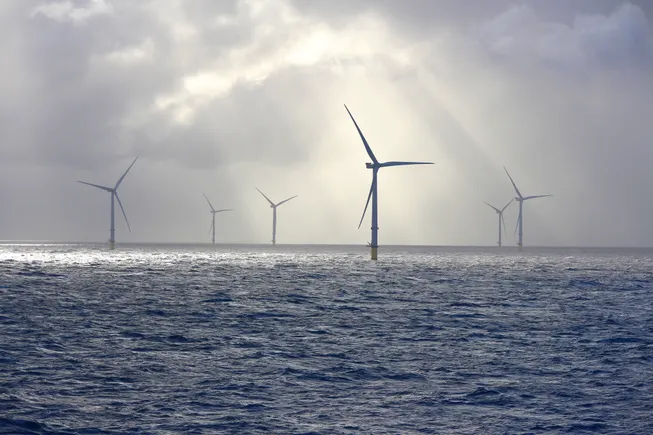
The Bureau of Ocean Energy Management's (BOEM) first offshore wind lease sale in the Pacific Ocean drew lower bid prices than comparable sales on the East Coast, a result that experts say reflects the uncertainties facing California's offshore wind industry but could ultimately benefit ratepayers.
"[This] definitely was not the super competitive auction that I was expecting," given the excitement over establishing a California offshore wind industry, the state's ambitious planning goals, and the push to develop floating offshore wind in the U.S., said Samantha Woodworth, senior research analyst with Wood Mackenzie.
The lease sale attracted winning bids from five companies totaling $757.1 million for five lease areas covering more than 370,000 acres off central and northern California. BOEM estimates the areas could generate approximately 4.6 GW of offshore wind energy. However, the winning bids averaged $2,028 per acre—lower than the $2,861 per acre average from the May auction in the Carolinas and the $8,951 average from leases in New York and New Jersey in February.
Many project developers recognize that global supply chain issues and high inflation trends are not easing soon, making some wary of committing to massive investments, Woodworth said.
"Lower bid prices are a way of penny-pinching where developers can. And also, I think a lot of developers are [thinking] it's kind of a weird time right now—let's proceed with caution, let's take it easy," she added.
But those lower bid prices could have an advantage—they translate to lower upfront costs for developers, which could lead to lower power purchase prices for offshore wind that ultimately flow through to consumer electricity rates. They may also allow leaseholders to invest in building an offshore wind supply chain in California.
"So not only does it behoove the industry to keep those bid prices low, because it keeps their overall project costs down—but it also increases their probability of getting [the projects] approved by the powers that be, by the utility commissions [and] the state," Woodworth said.
Now, industry advocates say California needs to focus on creating a permitting plan for offshore wind projects, developing ports to support the new industry, and determining the transmission infrastructure needed to bring offshore wind energy onshore.
Lease Sale Results: Surprises and Encouraging Trends
BOEM's California lease sale represents "a significant milestone" toward the Biden administration's goal of installing 30 GW of offshore wind capacity in the U.S. by 2030 and 15 GW of floating offshore wind by 2035, the bureau said in a statement announcing the results. Five companies were named provisional winners: RWE Offshore Wind Holdings, California North Floating, Equinor Wind US, Central California Offshore Wind, and Invenergy California Offshore.
The U.S. West Coast is "one of the most attractive growth regions for floating offshore wind in the world due to its favorable wind conditions and proximity to markets that need reliable, clean energy," Equinor Wind US President Molly Morris said in a statement. Equinor secured a roughly 2 GW lease in the Morro Bay area off central California, spanning more than 80 acres. The company also operates two other lease areas—Empire Wind and Beacon Wind—off the Northeast coast.
"We don't have enough investments in ports, we don't have a clear offtake plan and we do not have transmission plans to the North Coast, at least."
Nancy Rader, Executive Director, California Wind Energy Association
For the industry, the lease sale results included surprising outcomes and encouraging trends, according to Sam Salustro, vice president of strategic communications with The Business Network for Offshore Wind. Bid prices were lower than the East Coast, but they indicate confidence in a new market that lacks a clear path to offtake agreements and still needs ports, supply chain, and workforce development, Salustro said.
The surprising part, he noted, was that only seven bidders participated in the auction, despite 43 being pre-qualified. These seven were largely developers already active in the U.S. market.
"I think that's surprising because there are a lot of floating [offshore wind] developers globally and we may have thought that… some of them may have gotten involved. But they stayed out and it was people already in the American market who won the leases—which sort of signals that while there is a lot of confidence in the American market, the people who have the most confidence are the ones who are actively engaged with it," he said.
Salustro and other experts aren't surprised the bid prices were lower than those seen in the New York Bight auction earlier this year, which drew winning bids of about $4.4 billion from six companies.
"That was a perfect storm, because they had the ports, they have a supply chain, they have an offtake, they have a workforce that's developing—we're probably not going to see those prices again for a long time here in the American market," he said.
Nancy Rader, executive director of the California Wind Energy Association, also believes the auction results reflect California's lack of a clearly charted path to establish the offshore wind industry, which translates to higher risk for developers and lower lease bids.
"We don't have enough investments in ports, we don't have a clear offtake plan and we do not have transmission plans to the North Coast, at least," she said.
In fact, California's offshore wind industry still lacks certainty on what final offtake agreements will look like. These projects are large in scale, and it can be difficult for some load-serving entities—like smaller community choice aggregators—to procure power from them, said Michelle Solomon, policy analyst at Energy Innovation.
One way experts suggest the state can address this is by creating a central procurement agency to purchase the energy and sell it to smaller entities, according to Solomon.
Another uncertainty is that California is trying to deploy floating offshore wind, a relatively new technology. The East Coast has shallower waters, allowing for fixed-bottom turbines that are common worldwide. California's waters are much deeper, requiring floating turbines tethered to the ocean floor with cables. Floating turbines are mature for depths of a few hundred meters, but California's lease areas are at depths of roughly 800 to 1,000 meters, she added.
"There's just more to be done to get the industry up and running in California… so [it's] not surprising that the lease sale is a little bit less than New York. I would say this is still a high total," Solomon said.
The lower bid prices have an ancillary benefit, said Rader. Astronomical bid prices on the East Coast risk pushing up power purchase prices. Moreover, that money goes to the federal government rather than meeting infrastructure needs like transmission and port development in California.
"So in that sense, it's good that the bid prices are lower, because it will affect power purchase prices to a lesser extent," she said.
Going Forward: Ports, Transmission, and More Call Areas
Offshore wind can play a critical role in California's energy mix as the state transitions to a decarbonized grid. The state has relied heavily on solar power, but wind can complement solar as it often blows when the sun sets, said Laura Deehan, state director of Environment California.
In August, California regulators adopted offshore wind planning goals of 2 GW to 5 GW by 2030 and 25 GW by 2045. Those goals provide a critical boost to the industry, experts say.
"Our whole thinking was we wanted to show investors and the energy industry, the folks who are building offshore wind in other parts of the world… that California is really serious about going big on offshore wind," Deehan said.
"The state, as you know, has set a goal for 25 GW by 2045, so we need more call areas to enable us to achieve that goal."
Adam Stern, Executive Director, Offshore Wind California
Looking ahead, California will need a clear roadmap for permitting offshore wind projects, a strategy to develop ports that can deploy and service turbines, a plan to site and construct transmission, and a procurement policy for the energy itself, according to Adam Stern, executive director of Offshore Wind California.
"And we need additional call areas," he said. "It was terrific that this auction was as successful as it was, but according to BOEM, the combined capacity of the areas [is] 4.6 GW. The state has set a goal for 25 GW by 2045, so we need more call areas to achieve that goal."
For developers, the next steps involve engaging with affected communities to assemble benefit packages and focusing on construction and operation plans that comply with environmental considerations, said Solomon.
On the regulatory side, the California Public Utilities Commission needs to integrate offshore wind into its long-term planning and require procurement, preferably through a central entity, according to CalWEA's Rader.
There's still a long road ahead before turbines off California's coast generate power, experts say.
"A big issue in our view is are we going to get any of the economic benefits from this thing? Are we going to build any of this stuff in California?" Rader said. "We're working very hard to make sure that we're building at least some of the floating platforms in California. That's the biggest ticket item we can most likely capture."
However, the state currently lacks adequate port space to build these platforms, which can be the size of football fields, Rader said.
"That's a challenge—and if we can't figure out a way to build out the ports… we won't get many of these economic benefits," she said.
Environmental impacts present another challenge, according to Julia de Lamare, clean energy advocate with the Natural Resources Defense Council.
"Floating turbines are a new technology that has never been tested in the United States, which means the impacts on marine life, fisheries, Indigenous people, among others are unknown," she said in an email.
Regulators must advance environmentally responsible offshore wind development, de Lamare said, suggesting that leaseholders commit to avoiding and minimizing environmental impacts and conduct additional research to fill data gaps.
