
2025 Renewable Energy Outlook: Trump's Second Term Begins, Industry Moves at Full Speed
2025 Renewable Energy Industry Outlook: IRA continues to stimulate investment, load growth brings new opportunities, but grid congestion and permitting challenges remain, with Trump's second-term policy direction becoming a key variable.
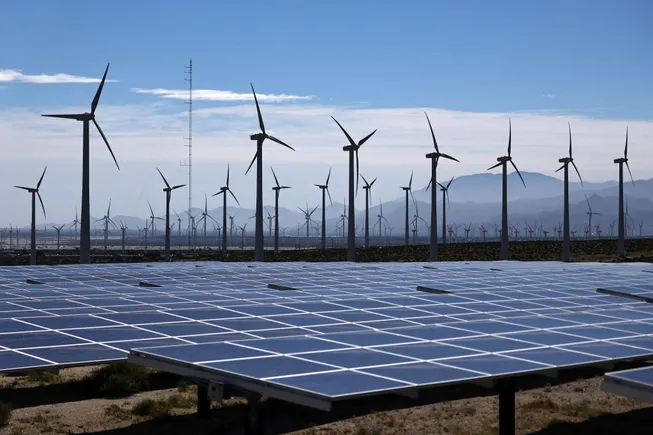
As 2025 begins, the renewable energy industry faces record investment driven by the Inflation Reduction Act (IRA) and new deployment opportunities from surging load, while also grappling with interconnection queue congestion, siting and permitting, and financing challenges, as industry critic Donald Trump begins his second presidential term.
"It's an interesting moment because changes are happening very quickly, but we're still stuck in some key areas," said Heather O'Neill, president and CEO of Advanced Energy United. "The interconnection queue is a clear example—while there's been some progress, like FERC rolling out reforms—we haven't yet unlocked the full potential and the economic opportunities and dynamism that could be realized."
After decades of flat load growth, U.S. electricity demand could increase by 128 gigawatts (GW) over the next five years, according to a Grid Strategies report last month. Meanwhile, new transmission interconnection requests have grown by 300% to 500% over the past decade, with 2.5 terawatts (TW) of clean energy and storage capacity currently waiting to connect to the grid, the U.S. Department of Energy (DOE) reported in October.
However, O'Neill said, "the macro trends are very positive...we are in the middle of an energy transition." She attributes some of her optimism to the scale of investment and growth the industry continues to see.
O'Neill noted that the storage sector is particularly active right now: "A few years ago, storage capacity rarely appeared, but with a lot of innovation in technology, cost curves are coming down. When thinking about how to manage load, storage plays a key role."
Global energy storage installations surged 76% in 2024 and are expected to continue that momentum in 2025, according to a November BloombergNEF report, but the firm noted growth could be affected by "uncertainty from the new Trump administration."
Trump has publicly opposed electric vehicles and said he would "rescind all unspent funds under the Inflation Reduction Act." Congress is expected to attempt to claw back EV tax credits in the IRA, which could impact the battery industry. Trump has also said he would end offshore wind "on day one" and supports oil and gas power generation, but last month he pledged to expedite federal permitting and environmental reviews for construction projects valued at $1 billion or more—a move that could benefit clean energy.
Felicia Sanchez, a partner in the maritime and finance practice at law firm K&L Gates, said Trump's goal of ending offshore wind could conflict with his goals of boosting the U.S. economy and domestic manufacturing.
"When you're also affecting a massive supply chain that's been in place over the last few years, involving port development, vessels that have started construction or have already been built and are ready to go out for offshore wind operations, it's hard to say 'we're going to end offshore wind,'" she said.
The need to meet electricity-side load growth won't disappear. Any administration—whether Republican, independent, or Democratic—will prioritize a strong and resilient economy. And that will depend on a first-class transmission and distribution grid.
— Paul DeCotis, Senior Partner and East Coast Energy & Utilities Lead at West Monroe
John Northington, a government affairs advisor and member of the public policy and law practice at K&L Gates, expects the offshore wind industry may adapt to the new administration by shifting its messaging focus away from "the primary message that steel in the water is good for the environment."
"Maybe for the next four years, the focus will be that steel in the water means jobs, money, and is good for America," he said. "Talking about commercial benefits rather than environmental benefits could be a shift in trend for these companies."
Northington also told Utility Dive in December that he was hopeful about the bipartisan Energy Permitting Reform Act of 2024, co-sponsored by Sen. Joe Manchin (I-W.Va.) and Sen. John Barrasso (R-Wyo.)—but it was not included in the continuing resolution passed later that month, "which leaves permitting reform in this Congress on the shelf," Manchin said, as he retired in early January.
Grid faces new demand
Regardless of how Trump's second term shapes the U.S. generation mix, his administration will contend with expectations of 3% annual load growth over the next five years—a level not seen since the 1980s, according to a December Grid Strategies report.
"The need to meet electricity-side load growth won't disappear. Any administration—whether Republican, independent, or Democratic—will prioritize a strong and resilient economy," said Paul DeCotis, Senior Partner and East Coast Energy & Utilities Lead at West Monroe. "And that will depend on a first-class transmission and distribution grid."
The surge in load growth is primarily driven by data center demand. A December Lawrence Berkeley National Laboratory report found that data center electricity use has tripled over the past decade and is expected to double or triple again by 2028. Demand growth also stems from industrial electrification and domestic manufacturing expansion.
This growth "means continued capital investment in the energy sector, regardless of administration changes," DeCotis said. "I don't think any administration wants to come in and suddenly have rolling blackouts or outages, or not have enough capacity to meet demand, or have to suppress demand and the resulting job growth because they can't meet energy needs."
O'Neill believes states will also continue to drive the clean energy transition because "energy policy happens at the state level...that's where investments become reality."
Governors and utility commissioners "want manufacturing in their states," she said. "They want data centers in their states. The siting reform conversation, I don't think it's a partisan issue; it's: how do we help unlock some of the economic activity that's desired? For us, regardless of what's happening in Washington, siting and building issues will be the work we advance in the states."
Projects driven by the IRA aren't limited to blue states. For example, we're working on projects across the country and seeing that places like Ohio and Pennsylvania, where things didn't work before, are now moving forward.
— Dan Smith, Vice President of Markets at DSD Renewables
Beyond states and utilities, companies like Microsoft, Amazon, and Meta are also driving clean energy demand—investing billions in renewable energy deployment while also pursuing nuclear and natural gas generation to address their data center load.
Molly Jerrard, head of demand response at Enel North America, expects "significant load growth...to test grid flexibility and challenge reliability on localized systems" in 2025.
"Combined with aging infrastructure, congestion, and increased climate-driven stress on the grid, utilities and grid operators will need to place greater emphasis on adopting demand response programs and distributed energy resources to address these challenges and improve grid stability," Jerrard said.
However, she noted that utilities' "inconsistent data access standards" continue to limit the scalability of virtual power plants (VPPs), which are an effective demand response solution.
O'Neill is excited about VPPs, seeing "a lot of innovation" flowing into the space and expanding the ways VPPs provide grid flexibility.
"We're seeing utilities and regulatory commissions in different parts of the country—whether coastal or Texas—really testing virtual power plants," she said. "They're managing load, shaving peak load, and thereby avoiding the need to build more generation."
Solar and offshore wind
In 2025, the American Clean Power Association (ACP) forecasts utility-scale solar installations will shrink 16% from 2024, due to risks of new tariffs under Trump's second term and concerns he may push Congress to repeal parts of the IRA.
The industry's residential solar segment "continued to decline" last year, largely due to California, where residential solar shrank significantly after the state shifted from net metering to net billing in 2023, according to a Solar Energy Industries Association (SEIA) Q3 2024 report.
Although solar projects in the state "don't provide the savings they once did," said Dan Smith, Vice President of Markets at DSD Renewables, "we still see California as our largest market."
Part of the reason is that California utility rates "continue to rise at extreme levels," he said. "So, while we've been adversely affected by NEM 3.0, as rates go up, customer savings increase, which somewhat makes up for the gap."
Smith said DSD Renewables enters 2025 concerned about potential repeal or reform of IRA solar tax credits, but hopes the Trump administration and Congress will see their value.
"Projects driven by these policies aren't limited to blue states," he said. "For example, we're working on projects across the country and seeing that places like Ohio and Pennsylvania, where things didn't work before, are now moving forward."
Smith said his concerns about potential tariffs would be alleviated if the domestic content bonus in the IRA is preserved and domestic solar supply continues to come online.
"But that's the question facing the entire industry right now—will these suppliers continue to invest in their domestic factories?" he said. "Many factories are under construction or planned, and the biggest question on many of our minds is whether federal policy will change, causing these companies to scale back their commitments?"
Many in the offshore wind industry are also "holding their breath," Sanchez said, "waiting to see what happens when Trump takes office at the end of January."
Shares of offshore wind companies like Ørsted and Vestas fell after the election and have not recovered. Sanchez sees this as a "temporary signal," depending on what actions Trump takes on offshore wind.
"There's been massive investment, and even this year, with the industry taking a more cautious approach, investment continues," Sanchez said. "I think that will continue to be the case. But again, right now everyone is in a pause, waiting to see what happens in the coming months to determine whether it's worth continuing to add investment."
On his first day in office, Trump issued an executive order pausing offshore wind lease sales in federal waters, as well as approvals, permits, and loans for onshore and offshore wind projects. Under the order, these pauses have no set expiration date and will remain in effect until revoked.
We don't expect, and I think many people don't expect, that the IRA will be completely overturned and destroyed.
— Marlene Motyka, U.S. Renewable Energy Leader at Deloitte
Northington finds Trump's choice of former North Dakota Governor Doug Burgum to lead the Interior Department encouraging, as Burgum oversaw the development of onshore wind in his state during his tenure.
"I think Trump's energy policy is truly anti-wind, but in terms of getting things done, it's more pro-oil and gas," he said. "At the end of the day, it takes effort and energy to tear something down, while ignoring something takes much less effort."
However, Northington worries that the high turnover of political appointees in Trump's first term could continue into his second, and career staff at agencies like the Bureau of Ocean Energy Management might choose to retire. People might say, "'Well, I survived the first round—do I have to survive a second one?'" he said. "I think that could have some adverse impact on things like getting permits or holding lease sales."
Solar and offshore wind are both continuing to advance technologically, with promising innovations ahead. Sanchez said there is "still a lot of discussion" about the future of offshore wind, floating wind, and the technology and infrastructure needed on the West Coast to support floating wind.
The solar industry benefits each year from "continuous improvements in solar module efficiency," Smith said. "Now we're almost exclusively using bifacial solar modules, which increases power generation."
Marlene Motyka, U.S. Renewable Energy Leader at Deloitte, said she hopes solar cell technology will continue to advance through further innovation in materials like silicon and perovskite, and is excited about a December SEIA and Wood Mackenzie report stating that U.S. solar module factories now have the capacity to meet nearly all domestic demand.
Motyka said Deloitte expects "good momentum" for the industry in 2025: "We don't expect, and I think many people don't expect, that the IRA will be completely overturned and destroyed."
"Many things have been gradually converging, and it won't happen overnight," she said. "I've been in the renewable energy industry for 17 years, and now all the factors are coming together. I think this is still an exciting time."
