
Customer-Owned DER Aggregators Challenge Xcel's Owned Batteries: The Minnesota Virtual Power Plant Model Debate
Xcel Energy's Capacity*Connect (C*C) pilot project filed in Minnesota, which plans to deploy up to 200 megawatts of behind-the-meter batteries, has drawn criticism from customer-owned distributed energy resource aggregators. The debate centers on cost-effectiveness, market competition, and resource control, while virtual power plant projects in other states demonstrate different models. Regulators are expected to make a decision by mid-2026.
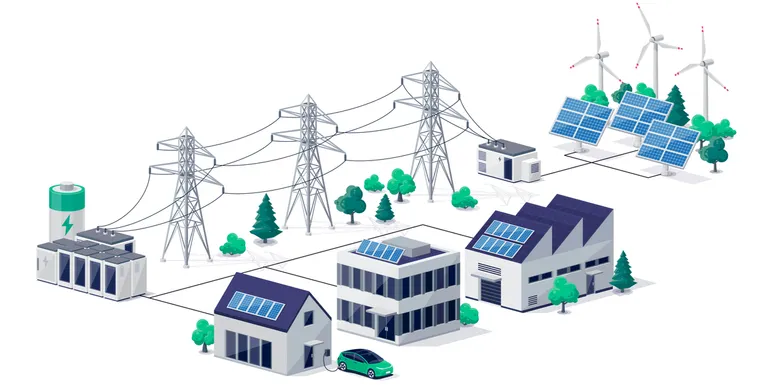
A new type of energy storage project proposed by Xcel Energy in Minnesota is drawing attention for its impact on how distribution system resources are managed—and, amid the increasing decentralization of the U.S. power system, for who will own and control these resources.
Xcel calls its Capacity*Connect (C*C) pilot a "first-of-its-kind" "distributed capacity" project and filed it for regulatory approval with the state public utilities commission in October.
If approved by regulators, Xcel will deploy up to 200 MW of front-of-the-meter batteries at "strategic locations" on its distribution network by 2028, with individual battery capacities ranging from 1 MW to 3 MW. Xcel will retain ownership of the batteries and pay third parties to host them on their property. The project's proposed budget ranges from $152 million to $430 million.
The proposal has drawn criticism from some stakeholders, especially aggregators of customer-owned distributed energy resources, who argue the utility is engaging in anticompetitive behavior and will harm ratepayers.
C*C "will cost more" and "won't bring resources online faster," said Amy Heart, senior vice president of public policy at Sunrun, which operates one of the largest virtual power plants in the U.S.
But other virtual power plant advocates argue that utility-owned resources and aggregated customer-owned resources are not mutually exclusive.
"Providers of both business models claim their option can meet anticipated load growth in the most cost-effective way, and both are correct," said Ted Ko, founder and executive director of the Energy Policy Design Institute (EPDI). "The type of virtual power plant the system needs depends on a granular understanding of the system services required."
Minnesota regulators are expected to decide on C*C by mid-2026.
Currently, virtual power plants are gaining attention nationwide. States such as Maryland, Illinois, and New Jersey are requiring utilities to develop related projects. States like Michigan and New Mexico are considering legislation. State requirements and models vary, and stakeholders say this could both accelerate innovation and spark state-by-state disputes.
A clash of two business models
Xcel executives say more than 65% of C*C's revenue will come from providing bulk system capacity (i.e., resource adequacy) to the Midcontinent Independent System Operator (MISO).
That revenue will benefit all Xcel Minnesota customers, said Zach Pollock, director of grid strategy and emerging technology at Xcel Energy.
The batteries will also help meet storage needs identified in Xcel's 2024 integrated system plan, said Lon Huber, senior vice president of integrated system planning and chief planning officer at Xcel. As owner and operator, Xcel "is uniquely positioned to maximize the benefits of distribution system storage, more so than a system operator or third party," he added.
However, the utility is taking a different approach in Colorado. The Active VPP (AVPP) project is authorized by Colorado Senate Bill 24-218, Pollock said. Third-party aggregators will register and manage 25 MW of behind-the-meter customer-owned distributed energy resources annually for five years.
In Maryland, Baltimore Gas and Electric's DCP proposal is awaiting regulatory guidelines.
But key aggregated distributed energy performance data will be released in Illinois at the end of 2026, from virtual power plants authorized by the 2025 Clean and Reliable Grid Affordability Act (CRGA), said Scott Vogt, vice president of strategy, energy policy, and revenue programs at Commonwealth Edison (ComEd).
Under CRGA's seasonal scheduling, the utility will work with aggregator-led virtual power plants starting in spring 2026 to reduce ComEd's costs in the PJM Interconnection capacity market, Vogt said.
In Minnesota regulatory filings, supporters and opponents detailed their concerns about Xcel's DCP.

Aggregator-led virtual power plants
Illinois and Colorado projects will be aggregator-led and demonstrate what can be achieved without utility ownership, said Sunrun's Heart and other solar advocates.
"The most cost-effective way for ComEd to quickly ensure it meets summer peak demand is by using distribution system resources," Vogt said. Participating customers will receive upfront enrollment rebates and nominal annual participation payments this year, and the utility will recover these costs through rates, Vogt added.
All-customer benefits from lower system-wide capacity costs will not be allocated until the PJM 2029-2030 forward capacity auction, Vogt said. These benefits will be delayed due to regulatory and accounting complexities of operating through the MISO market, he added.
ComEd did not consider Minnesota's C*C business model because "Illinois regulations do not provide a clear direct path for utility asset ownership as other states do," Vogt said.

Cost-effectiveness differences
The cost-effectiveness of Xcel's C*C is a key point of debate.
According to filings from solar stakeholder groups, its estimated price is $2,150 per kilowatt (for 200 MW). Xcel's Colorado aggregator-led AVPP project has an estimated cost of $624 per kilowatt (for 125 MW), the filing added.
Industry estimates of benefit-cost ratios for aggregator-led virtual power plants and pilots in 22 states are higher than C*C's expected 0.96, another solar group filing said.
The Minnesota Attorney General added in a December 10 filing that Xcel did not quantitatively compare "the costs and benefits of utility ownership versus customer or third-party ownership."
But Xcel's initial filing said the C*C proposal does provide the required "qualitative" analysis involving utility-owned DCP as well as "customer-owned and third-party-owned resources." Xcel added in an email that quantitative analysis was not required and that Xcel does not have access to third-party cost structures and ownership models.
There is a reason CRGA legislation and Colorado legislation exclude utility-owned distributed energy resources, said Sunrun's Heart. DCP is "a short-sighted project that is slower, less effective, and will ultimately cost ratepayers more," she added.
Comparing the costs and benefits of "fundamentally different" projects in Minnesota and Colorado is wrong, Pollock said. The Colorado project's costs are based on payments for the use of customer-owned assets over five years, while C*C's large batteries are 20-year utility assets, he added.
"It is not yet clear which type of flexibility is more cost-effective," said Brian Seal, chief technical director of the Distributed Energy Resources Integration Flex-It program at the Electric Power Research Institute (EPRI). Based on several cost-benefit studies he has conducted, "it depends on the specific technology type and quantity," he added.
Large batteries typically last up to 20 years, while consumers do not make "long-term commitments" to aggregation projects, Seal said. Additionally, the availability of behind-the-meter DER aggregation varies with weather, season, time of day, and consumers' "interest and willingness," he added.

Competition objections
Another key point of contention about C*C is that "it is not compatible with competitive markets," Heart said.
A filing from the R Street Institute (written by Chris Villarreal, a former Minnesota commission staffer and now a senior fellow and consultant at the R Street Institute) echoes that view.
"System services are often put out for bid by utilities because many regulators see the value in learning market prices," Villarreal told Utility Dive. Competitive procurement "introduces cost discipline," which is especially important because "utilities have a capital investment bias," he added.
Xcel Minnesota's competitive procurement of hardware and development services with Sparkfund does not equate to putting system needs out for bid, Villarreal said. This would require a technology-neutral competitive solicitation for distribution capacity, or at least allowing Sparkfund's competitors to serve as implementers of the DCP, he added.
"Xcel's exclusive selection of Sparkfund to operate C*C may be using ratepayer funds to support Xcel's non-regulated investments," the Attorney General's January 27 filing added.
Finally, Villarreal said Xcel's claim that utility ownership is the only way to protect reliability and cybersecurity is misleading. Xcel could state its situational awareness needs and incorporate them into contractual obligations for market bidders, he added.
"Utility ownership can also distort markets by causing utilities to prefer their own resources," said Kay Aikin, founder and CEO of Dynamic Grid, a software platform provider. "It will also be more expensive than aggregations of customer-owned DER because Xcel gets cost recovery and Sparkfund gets a margin," she added.
Xcel acknowledged in a January 9 filing that the C*C project was "conceived and developed" with Sparkfund in 2024. The filing added that Sparkfund is owned by venture capital fund Energy Impact Partners, which has more than 100 companies in its portfolio, and Xcel's parent company is a minority investor in the fund but does not participate in the operations of portfolio companies.
Xcel did not seek other project implementers because of Sparkfund's innovative approach to DCP, its filing said. Sparkfund will handle siting and development for C*C, with 80% of hardware and services selected through competitive bidding, but operational complexity precludes third-party aggregator involvement, the filing added.
For C*C, "different use cases" and "third-party ownership [are] premature," but "C*C will not displace or preclude third-party DER projects," the filing said. An integrated grid DER management system will maximize use of "existing infrastructure... as we move toward more dynamic operations," as well as the "broader DER ecosystem," the filing added.
C*C will be sited where possible to avoid negatively impacting hosting capacity needed by DER aggregators, the filing said. "The core principle of the project is to stack benefits wherever possible," which is why C*C's expected benefits "should not be viewed as a cap," the filing said.
Colorado lawmakers required working with third-party aggregators and customers, said Pier LaFarge, CEO of Sparkfund. Xcel "seems to want to scale and mature both business models to understand how their value combines to put downward pressure on rates and meet load growth," he added.
The "superpower" of behind-the-meter DER is that "customers need them, and ignoring these thousands or millions of assets would be absurd," LaFarge said. But "utility-owned batteries, like utility-owned transformers and substations, can be built where needed and dispatched without worrying about customer participation," he added.
Both have "excellent value propositions," LaFarge said. The DCP project is "a new way for Xcel Minnesota to expand its distribution-side capacity," he added.
DCP could give rise to utility-led "bring-your-own-offsite flexibility resource" projects, LaFarge said. This would allow large energy users to pay for customer-owned DER managed by aggregators rather than developing on-site generation or curtailing usage, he added.
Utility operational excellence is indispensable, said Dynamic Grid's Aikin. As electricity demand grows and distribution system upgrade costs rise, "every utility should have price signals and utilize virtual power plants and battery developers," she emphasized.

Room for both
Wood Mackenzie data shows that from 2024 to 2025, installed capacity of utility-scale batteries like those used in C*C grew by 4.6 GW (27%). But residential batteries in DER aggregations also grew by 70% (647 MW), the report added.
"The two types of virtual power plants are complementary," said EPRI's Seal. For specific needs like load surges, "it is difficult to ensure thousands of customer devices can be quickly enrolled," but if the need is "a slowly emerging issue like load growth approaching infrastructure limits, either utility or third-party can equally meet it," he added.
The Huels Test evaluation by DER management software provider EnergyHub shows that current customer-owned DER aggregations, while valuable, are not yet fully dispatchable like power plants. However, utilities can easily dispatch large batteries to reduce consumption, analysts and stakeholders agree.
"Virtual power plants alone are not the answer," said Xcel's Huber. "But all types of virtual power plants, such as DCP, plus new large-scale generation and transmission, large batteries and flexibility from customer-owned resources, and demand response programs, can meet the coming gigawatt-scale growth," he added.
Regulatory decisions should be based on specific needs, "and one regulatory decision does not set rules for all virtual power plants," said EPDI's Ko. "The long-term vision is for regulators to understand the value of each business model and for all DER to be properly compensated for all the services and benefits they provide."
Correction: This article has been updated to correct the expected benefit-cost ratio for the C*C project and to note that Scott Vogt retired from Commonwealth Edison before this article was published.