
Electricity Affordability Dispute Escalates, Utility Profits Face Dual Pressure from Regulation and Legislation
Electricity affordability issues are pushing the profit levels of U.S. utility companies into the political and regulatory spotlight. From protests at a conference in Las Vegas, Nevada, to the ongoing Pepco rate case in Maryland, the battle over return on equity (ROE) is intensifying. Consumer advocacy groups and utility companies hold opposing views, and the surge in electricity demand driven by the AI boom adds a new variable to the debate.
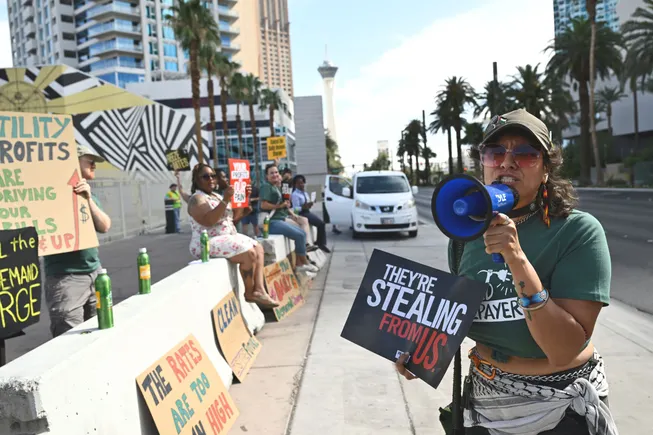
Last month, protesters angered by high electricity bills disrupted a meeting of executives from the largest investor-owned utilities in the U.S. in Las Vegas—a stark example of rising public anger that has forced the industry to again defend its legally protected profit margins.
As political pressure over electricity affordability grows, several states have taken steps through regulation or legislative action to lower utility returns on equity (ROE). Consumer advocates argue these measures are long overdue, while utilities say that suppressing ROE could affect their credit ratings, which could in turn translate into higher costs for customers.
Experts told Utility Dive that the combination of electricity's importance in the 21st century and its rising costs in the 2020s may be pushing acceptable levels of utility profits toward a tipping point.
In a potentially decisive Maryland rate case nearing a ruling, utility executives say the matter should be left to state regulators, while consumer advocates argue that regulators should push utility profits down closer to the cost of providing service to customers.
Utilities in the spotlight
With average electricity price increases across the country outpacing inflation, affordability has become a more urgent issue, and many are pointing the finger at utility companies. A Pew Research Center poll from March 2026 shows that 85% of respondents believe utilities "want to make more money" is a reason for rising household energy prices.
The impact of profits is not just about public perception. According to a series of reports from Lawrence Berkeley National Laboratory, investor-owned utilities, which account for about 70% of national electricity sales, have higher electricity rates that are rising faster than those of publicly owned utilities, which have less profit motive.
The reports also found that investor-owned utilities' revenue requests are higher than in past decades—totaling $18 billion last year—and that over the past five years, regulators have on average approved 64% of these increase amounts, compared with an average approval rate of 52% in the previous two decades.
The energy affordability issue is also intertwined with public resistance to data centers and their enormous resource demands. This discontent has won consumer advocates who question the regulated utility profit model a large and receptive audience.

According to Synapse Energy Economics, utility profit margins are set by regulators across the country, averaging 9.7% in 2025, with a range between 9% and 10.5%. According to the Regulatory Assistance Project's 2016 guidelines, ROEs in unregulated economic sectors may be at, well above, or well below that range, but they have no service obligation and do not need to seek approval for their profits like regulated utilities do.
Dani Marx, a spokesperson for the Edison Electric Institute, the industry organization for U.S. investor-owned utilities and their holding groups, said ROE falls under the jurisdiction of state utility regulators.
Marx said: "Independent state regulators assess infrastructure needs through open and transparent processes."
She added that utility infrastructure typically includes "an equity component, including the return on equity, to attract sufficient investment to fund these projects."
In December, California regulators lowered the ROE of its three largest investor-owned utilities by 0.3 percentage points each. Several states, including Pennsylvania, are considering legislation to tie utility ROE to the 10-year U.S. Treasury yield, along with other reforms.

ROE becomes politicized
Some states, such as Maryland, have begun to weaken utility returns through legislation, requiring electric companies to join regional transmission organizations to eliminate so-called "adders"—extra ROE that companies earn on transmission operations because of voluntary membership.
Meanwhile, state leaders in Virginia, New Jersey, and Pennsylvania have asked regulators to carefully consider rate requests, signaling they may take more direct action in rate cases.
The issue has also gained attention in Congress. Texas Democratic Rep. Greg Casar has gathered more than 20 cosponsors for the Lower Utility Bills Act (H.R. 8568). The bill would require utilities to "calculate ROE at the lowest return on equity within the reasonable range determined by their regulators."
Mark Ellis, a former Sempra strategy and economics executive who is now an independent consultant, said lowering utility profits "would save money on electricity bills for all electricity users." He added that, in his view, today's utility profits are "an unjust enrichment of utility investors at the expense of customers."
Utilities, for their part, argue that their profit margins must be set high enough to attract capital at low interest rates, which saves customers money in the long run while enabling utilities to maintain grid reliability.
Robert Leming, vice president of regulatory policy and strategy at Pepco Holdings, said that if a utility's authorized return is "lower than comparable utilities, its ability to attract capital will be at risk." Pepco Holdings is currently involved in the regulatory debate over profits before the Maryland Public Service Commission. He told Utility Dive that utilities need this capital "to provide safe and reliable service to customers."

ROE case study
Some believe the bottlenecks brought on by the AI boom are forcing utilities to consider alternatives beyond construction, but others worry the opposite is true—that the hype cycle is fueling ill-considered spending that customers will bear for decades.
The current Pepco rate case provides an illustrative example of this debate. The utility proposed raising its ROE from the currently approved 9.5% to 10.5%. The Maryland Office of People's Counsel proposed setting it at 7.7%.
David Lapp, head of the OPC, told Utility Dive that many of the utility's recent infrastructure investments could have been delayed.
Lapp said: "Pepco is investing too much, too fast, and not in projects that are cost-effective and needed for the future."
Pepco Holdings' Leming disagreed. He said: "Maryland's ambitious climate and electrification goals require investment to modernize and upgrade the system."
Ellis, Lapp, and others argue that high ROE is a perverse incentive because it biases utilities toward expensive investments that increase the utility's financing cost base, thereby raising ROE and increasing rates.
Furthermore, Lapp argues that Pepco's ROE is "inflated" by a financial strategy called "double leverage," which involves Pepco's sole investor—its parent company, Exelon Utilities.
The OPC argues that Exelon's lower-cost debt is being used by Pepco as higher-cost equity, allowing it to borrow more low-cost debt.
Lapp said double leverage "is not illegal if approved by regulators." But he added that if Pepco counts Exelon's debt as equity in its capital structure, it raises the overall ROE, thereby raising customer rates.
"The original idea of balancing the cost of service with benefits was the expectation that regulators would replace competitive forces, and that has been lost."

Karl Rabago
Former Texas utility commissioner
Pepco's advisor Adrien McKenzie told Maryland commissioners: "Exelon's role does not change Pepco's ROE requirements." He added that the equity supporting Pepco's operations "must be raised in the capital markets," and its return needs to be competitive with "comparable alternative investments with similar risk."
Pepco's Leming added that if Exelon invests debt to be repaid within 10 years into Pepco's 50-year assets, Exelon would not be repaid in time to meet its debt obligations.
To justify the proposed 10.5% ROE, McKenzie submitted multiple quantitative analyses and "a group of comparable electric utilities with similar risk." He testified that Pepco's credit ratings—Baa1 from Moody's and A- from S&P—were central to his conclusions.
McKenzie told the commission: "Rating agencies and potential debt investors often place great importance on maintaining strong financial metrics." He added that equity investors also place great importance on financial metrics and credit ratings.
Pepco's Leming told Utility Dive he focuses on utility operations.
He said: "Affordability is one of Pepco's top priorities right now." He added that recent rate increases are related to investments that have earned Pepco high rankings in customer satisfaction.
Leming continued, but Pepco must secure adequate funding to meet today's "unprecedented" demand and build new infrastructure. "This underscores the importance of having a competitive ROE to attract capital."
Lapp said his focus is on customers.
He said: "Everyone agrees that utility investors should have the opportunity to earn the same returns as entities with comparable risk. But Pepco's proposed 10.5% ROE is unfair to customers because its cost of equity is not just slightly lower, but significantly lower."
A ruling on Pepco's ROE is expected in August.

Seeking solutions
Lowering ROE can indeed affect a utility's credit quality. Several Connecticut utilities, including Eversource and Avangrid, have experienced credit rating downgrades as credit rating agencies pointed to inconsistent and unsupportive regulatory environments.
But Ellis said this impact can be offset. He added: "Increasing the equity portion of the debt-equity ratio and lowering ROE can save customers money without significantly changing a utility's credit rating."
Ellis is an advocate of "competitive direct equity," calling it "a structural and political solution." He explained: "It would replace administratively set ROE with an equity cost determined by supply and demand through competitive auctions, fundamentally changing the utility incentive structure."
Ellis continued that in today's rate cases, determining ROE "is a farce, with calculations that are neither coherent nor accurate." "The utility says it should be 11%, consumer advocates say it should be 9%, regulators split the difference at 10%, and then move on to the next proceeding."
Utilities are accustomed to receiving satisfactory ROEs through rate cases decided by state regulators, and there is no widely proposed alternative political solution. They warn regulators that reducing working capital will put grid reliability at risk.
But Karl Rabago, a former Texas utility commissioner who frequently represents consumers in rate case interventions, said utilities' rate filings—such as Pepco's—often contain complex ROE calculation formulas that overwhelm regulators and ultimately lead to the conclusion that utilities need higher ROEs.
Rabago said: "The original idea of balancing the cost of service with benefits was the expectation that regulators would replace competitive forces, and that has been lost."
An Exelon spokesperson said in a statement that the company understands customers' concerns about electricity affordability.
The company said: "Attributing rising customer bills primarily to utility returns overlooks the fundamental challenge facing the energy industry today: electricity demand is growing rapidly, while the supply of reliable generation is not keeping pace. Meeting the nation's growing energy needs requires both investment in new generation resources and continued modernization of the grid. We remain focused on making customer-centric investments, responsibly managing costs, and providing safe and reliable service to the communities we serve. We look forward to continuing to work with stakeholders to find solutions."
This article has been updated with comments from an Exelon spokesperson.