
PPL and Blackstone Joint Venture Locks in 5 GW of Gas Turbine Capacity for Pennsylvania Data Centers
PPL Corp. President and CEO Vincent Sorgi revealed on an earnings call that its joint venture with Blackstone Infrastructure, Invitium Energy, has locked in over 5 GW of gas turbine capacity for Pennsylvania data centers and has secured approximately 5 GW of interconnection queue acceptance from PJM. The joint venture expects to announce at least one power supply agreement this year, with potential investment reaching $15 billion by 2032.
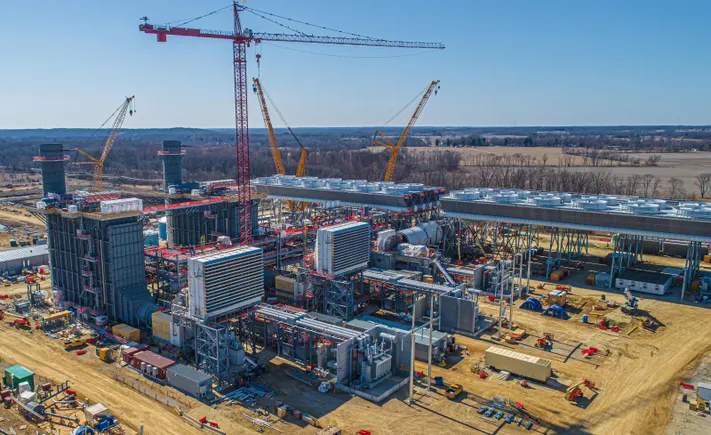
PPL Corp. President and CEO Vincent Sorgi said on Friday's earnings call that the company's joint venture with Blackstone Infrastructure, Invitium Energy, is expected to announce at least one deal to power data centers within this year.
PPL and Blackstone jointly formed Invitium last year to build, own, and operate power generation facilities for data centers in Pennsylvania under long-term energy supply service agreements.
According to Sorgi, the joint venture has secured sites in Pennsylvania that can support up to 14 gigawatts of new generation capacity and has signed reservation agreements for more than 5 gigawatts of combined-cycle gas turbines. PJM Interconnection has also accepted approximately 5 gigawatts of Invitium generation projects into its interconnection queue.
Sorgi noted that the secured gas turbines correspond to a potential investment of up to $15 billion through 2032. PPL holds a 51% stake in the non-utility joint venture.
PPL, headquartered in Allentown, Pennsylvania, said the joint venture is not expected to generate material earnings until the gas turbines are operational, with the earliest possible in-service date being 2031.
Sorgi said the joint venture could also generate revenue earlier by supplying battery storage to data center customers, but storage opportunities may be limited.
"Batteries are certainly the fastest to market, but they are also the easiest for hyperscale data center operators to embed in their own designs and make part of the data center construction project," Sorgi said. "I'm confident there will be batteries connected to the system by 2029, but some of that may be owned directly by hyperscale operators rather than by third-party generators like Invitium."
Key data at a glance
- 8.4 million megawatt-hours:PPL Electric's second-quarter electricity sales, down 0.5% year over year, partly dragged by a 4.7% decline in Pennsylvania industrial electricity usage. Weather-adjusted sales fell 0.6%.
- More than 6.5 gigawatts:Data center load under construction in PPL Electric's service territory, up from 5 gigawatts in the first three months of this year.
- $247 million:Second-quarter continuing operations earnings, up 3% from $240 million in the same period last year.
PPL Electric's advanced data center project pipeline grew 12% quarter over quarter in the second quarter to 31.8 gigawatts. Sorgi said the pipeline includes 11 gigawatts of data center projects with signed electric service agreements designed to ensure existing customers do not bear costs associated with new data centers.
Sorgi noted that two data centers in PPL Electric's service territory began taking service in the second quarter, and their load could climb to about 2 gigawatts by 2031.
In Kentucky, PPL's Louisville Gas & Electric (LG&E) and Kentucky Utilities (KU) have an 11.6-gigawatt data center project pipeline, roughly flat with the previous quarter. Sorgi said another 2.1 gigawatts of manufacturing and other non-data-center large loads are under development in Kentucky.
According to Sorgi, the two utilities' "probability-weighted" forecast shows 3.7 gigawatts of new load connecting to the grid by 2032, more than double the company's forecast from last year.
As a result, LG&E and KU may request state regulatory approval later this year for additional power supply resources to meet potential load. Sorgi said this could include 400 megawatts of battery storage, a 266-megawatt pumped storage project developed by Rye Development, and gas-fired combined-cycle units.
These projects correspond to a potential investment of $3.5 billion to $4 billion between 2027 and 2032, Sorgi said.
In Sorgi's assessment, an executive order signed by Kentucky Governor Andy Beshear (Democrat) on August 6 is unlikely to curb data center development in the state.
The executive order aims to ensure data centers do not harm ratepayers or the environment. Beshear requires data center developers to submit long-term energy supply plans to the state demonstrating that residential customers will not be harmed. The order also directs the state's Energy and Environment Cabinet to deny any data center siting permits that would negatively affect air or water quality—a provision that could impact new gas-fired power plants.
Sorgi told analysts he is not concerned.
"With our approved rate structure in the state, we are well positioned to align closely with the governor's executive order within that rate framework," he said. "So no concern at all."
Although PJM plans to hold a standby reliability auction in late September, Sorgi said PPL expects bilateral contracts to be the primary path for new generation capacity in PJM.
According to Sorgi, Invitium has not committed to participating in the standby auction, but the company has submitted a proposal to the matching phase of PJM's standby capacity process.
Meanwhile, legislative deliberations that would allow Pennsylvania utilities to self-build generation facilities appear to have been shelved, Sorgi said.
"I wouldn't say it's completely off the agenda," he said. "I think (lawmakers) want to see how some other items progress before deciding whether they need to use that lever... But as you know, there's a lot of activity at the Federal Energy Regulatory Commission (FERC) and PJM levels, so that legislation, I think for obvious reasons, is not the highest priority."