
Analysts Urge 'No-Regrets' Planning Strategies for Large-Scale Batteries and Green Hydrogen Development
Although advanced long-duration energy storage batteries and green hydrogen are considered key resources for a net-zero emission energy system, they face multiple uncertainties such as commercialization timelines and policy incentives. Analysts suggest that regulators and utility companies should adopt 'no-regrets' planning strategies as early as possible to ensure the reliable operation of the future power system.
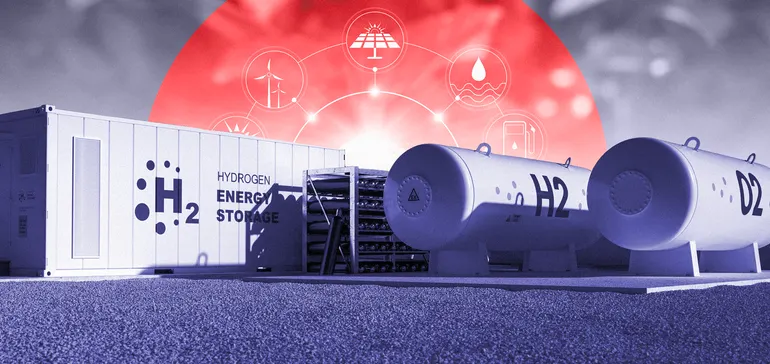
Advanced long-duration energy storage batteries and green hydrogen produced by electrolyzing water with clean energy are seen as potentially critical resources for a net-zero emissions energy system, but both currently face perplexing uncertainties.
First, the maturity timeline for these technologies remains unclear. Global advisory firm DNV stated on October 13 that they may not be ready until the late 2030s to early 2040s; Form Energy, however, claimed on December 22 that its 100-hour battery system would achieve "widespread commercialization" in 2024; the Rocky Mountain Institute (RMI) reported on October 11 that green hydrogen would "play a significant role in global decarbonization" before 2030.
Second, analysts point out that the significant long-term incentives provided for these two resource types in the 2022 Inflation Reduction Act (IRA), the 2021 Bipartisan Infrastructure Law, and the just-released National Blueprint for Transportation Decarbonization could further amplify this uncertainty. Green hydrogen and battery suppliers are competing for billions of dollars in new funding from the legislation, and both could win overlapping opportunities.
Jason Burwen, Vice President of Energy Storage at the American Clean Power Association (ACP), stated that these incentives are "changing the possibilities" for long-duration energy storage (LDES) technologies, such as Form Energy's batteries and green hydrogen, which can address prolonged system outages. But he added, "Neither has yet been deployed at grid scale, making this a race between two hypotheses."
However, utility planners and energy industry analysts agree that there may be synergies between advanced batteries and renewable hydrogen (RH2), or between them and other clean and reliable resources, in the post-2030 electricity supply.
Arne Olson, Senior Partner at Energy + Environmental Economics (E3), stated that achieving a "zero-carbon grid" requires "clean and reliable energy technologies," but advanced batteries and RH2 seem to have their own pros and cons, "and in the future, each can find a niche role in the market." He added, "It looks like a race now only because we cannot predict which technology will best fit the energy mix 20 years from now."
Analysts note that there is a general industry consensus that lithium-ion batteries are currently suitable for light-duty electric vehicles, while RH2 is the best clean energy option for heavy industry, which makes the long-duration energy storage prospects for the power sector full of uncertainty. But they add that with a high share of variable renewable energy, long-duration energy storage is crucial, and regulators and utilities can now apply "no-regrets" planning strategies to ensure the reliability and lowest cost of the future power system.
Current Certainties and Uncertainties
The core of the "no-regrets" strategy is to avoid outages caused by generation shortfalls, which could result in severe economic or human losses.
An August study by the U.S. Department of Energy's National Renewable Energy Laboratory (NREL) noted that when a net-zero power system reaches about 90% clean energy, a "no-regrets" strategy may require up to 680 gigawatts of cost-effective long-duration energy storage technologies to avoid potential prolonged generation shortfalls. The report stated that RH2, advanced batteries, or other clean and reliable energy technologies that have not yet been "deployed at scale" could address these generation shortfalls or "seasonal shortfalls."
NREL stated that the "gradual transition" to higher electrification after 2030, changes in load characteristics, and a generation mix dominated by variable renewable energy will lead to seasonal supply-demand "mismatches." Such mismatches can be addressed by long-duration energy storage. But the report added that because LDES technologies are dispatched infrequently, their costs "must be recovered from fewer generation runs than units that operate more frequently," thus facing economic challenges.
A May 2022 paper by the LDES Council in collaboration with McKinsey noted that at high renewable penetration levels, renewables and short-duration lithium-ion batteries also carry a "significant cost premium" due to the need for overbuilding to ensure reliability. The paper added that "LDES has the potential to significantly reduce this cost premium" because it may be cheaper than the required large-scale overbuilding of renewables.
However, NREL stated that scaling up unproven long-duration energy storage technologies requires "significant infrastructure development" as well as "raw material supply, manufacturing facilities, and a trained workforce." The report added that "coordinated" research, development, and pilot deployments are needed "to reduce costs and improve performance."
Julia Souder, Executive Director of the LDES Council, added that each LDES technology "has different tipping points in different applications." She stated that new policy approaches that "prepare for tomorrow today" and proactive utility planning are also needed to determine "the best LDES solution for each application."
In the absence of policy and planning guidance, utilities and other institutions studying reliability issues have as many questions as answers about LDES solutions.
Chico Hunter, Manager of Innovation and Development at Salt River Project, stated at the Electric Power Research Institute's Seasonal Energy Storage Symposium on November 9 that seasonal energy storage could play a role in a fully decarbonized energy system. But he added that without "advances in technology, carbon policy, and economic viability," LDES technologies will not be "commercially ready."
Andrew Hegewald, Manager of Gas Business Development at Dominion Energy, stated that "until the costs, performance, and regulatory environment of these technologies are further clarified," many of these topics in the utility industry remain "up in the air." Hegewald declined to further describe Dominion's work on LDES options.
Ashkan Nassiri, Manager of Strategic Planning at the Los Angeles Department of Water and Power (LADWP), stated at the symposium that lithium-ion batteries and other existing commercially competitive storage technologies can "get us most of the way on the path to 100% renewable energy."
Nassiri stated that seasonal storage needs could ultimately be met by RH2 power generated from LADWP's still-under-development Intermountain Power Project in Utah. But he added that the utility is "open to all promising technologies," and other LDES solutions are also under consideration.
Erin Childs, Director at Strategen Consulting, stated that many utilities now recognize that traditional regulatory approaches cannot meet the upcoming gigawatt-scale LDES demand. And scaling pilots from megawatt-scale trials to hundred-megawatt scale takes years, "which is too slow to determine when and how each LDES technology will be used."

The Current State of RH2 and Batteries
Analysts agree that the Biden administration's incentives provide funding but also raise questions about how to support RH2 and advanced batteries in the future energy mix.
Thomas Koch Blank, Senior Principal at RMI's Climate-Aligned Industries program, stated: "Batteries consume and regenerate electrons," while "hydrogen is a molecule that is typically consumed as a liquid or gas for heat in heavy industry."
Currently, industrial hydrogen is mainly produced from natural gas through steam methane reforming as gray hydrogen, estimated to cost $1.50 to $2.00 per kilogram. But Energy Innovation (EI) stated that the IRA's $3 per kilogram tax credit for near-zero-emission RH2 could soon make its current cost of $4 to $8 per kilogram competitive with gray hydrogen.
Dan Esposito, Senior Policy Analyst for the Electricity Program at EI, and Strategen's Childs agree that the "best use" of RH2 molecules is to eliminate emissions from large industrial processes such as fertilizer, cement, glass, or steel production, where heat demand cannot be met by electricity.
Jacob Susman, CEO and co-founder of Ambient Fuels, added that RH2 can decarbonize heavy industry faster and more cost-effectively than electricity because it is "the most competitive green molecule on the market today."
EI's Esposito stated that today's shorter-duration lithium-ion batteries may be better suited for light-duty electric vehicles because they outperform RH2 in "cost and performance." He added that a national charging network for light-duty EVs, which could eventually serve heavy-duty transportation, is already under construction, which should be a concern for regulators considering investments in green hydrogen for transportation.
But E3's Olson, EI's Esposito, and RMI's Koch Blank all agree that the best power source for heavy-duty transportation remains uncertain.
Strategen's Childs stated that this is an uncertain area because "lithium-ion batteries may face supply or range issues, while RH2 may lack the delivery infrastructure to meet demand." She added, "Both need to develop before it becomes clear which technology is more cost-effective in which application."

The Biggest Uncertainty
Childs and most others agree that which LDES is best suited for power system reliability remains the biggest question.
According to the LDES Council, there are four types of LDES. Chemical types (such as RH2) release energy when molecular bonds break, electrochemical batteries release electricity when chemical components react, thermal systems use temperature differences to generate heat or electricity, and mechanical systems store and release potential energy as electricity.
The LDES types currently considered best suited for power system use cases are RH2 and long-duration batteries.
Nidhi Thakar, Vice President of Policy and Regulatory Affairs at Form Energy, stated that the company is scaling up manufacturing of its 100-hour "iron-air multi-day battery," with commercialization planned for 2024. She added that analyses independently validated by utilities predict that Form's cost and performance targets will unlock tens of gigawatts of multi-day storage demand in the U.S. by 2030.
She added that Form's batteries could save consumers "billions of dollars" by reducing the need to overbuild new renewable energy to meet peak demand, and by lowering "land requirements and transmission costs." But a fully decarbonized power system "will require multiple solutions," and "the key is making the right trade-offs," Thakar said.
Ambient's Susman stated: "It is too early to pick winners and losers for LDES now." He said, "Form Energy and other battery technology developers are working hard," but RH2 "is already used in limited applications and pilots," and "IRA tax credits could bring significant growth."
ACP's Burwen stated: "The future of clean energy may depend on how quickly transmission lines and fuel pipelines for green hydrogen are built." He said that transmitting electrons is more efficient, but "transmission constraints due to siting and permitting issues may push power suppliers toward green hydrogen, especially under IRA incentives."
RMI's Koch Blank stated that RH2 is better positioned for seasonal storage "because it has a large customer base in industrial uses," which can derive "additional value" from supplying stored RH2 to address power system fluctuations. Batteries' main market in transportation similarly benefits them. But he stated: "This is not an 'either/or' choice, as current and new use cases can keep both technologies viable."
Strategen's Childs agreed that investments in transportation and industry over the next decade could allow both RH2 and long-duration batteries to scale up. She added that this could lead to "power system planning tools and market structures" that value flexibility in power system applications, "making both viable LDES options."
RMI's Koch Blank noted: "Lithium-ion batteries were initially developed for consumer electronics, but new use cases in electric vehicles and distributed solar reduced costs, making them a distribution system resource." He added that producing RH2 to replace gray hydrogen "could similarly lead to its use as a flexible power system asset."
Koch Blank stated: "It is easy to make a compelling argument for batteries or green hydrogen, which suggests a hypothetical competition, but both will impact the future power system in their own ways."

From "No-Regrets" to LDES
When electricity supply cannot meet demand, the regret of poor choices in the energy industry can be measured in human consequences, such as the February 2021 Texas blackout, which caused at least 210 deaths and $80 billion in economic losses.
E3's Olson stated that the conditions regulators must prepare for "depend on the system, load conditions, and available resources." He added that "the more diversified the portfolio, the less likely it is to be affected," and the only way to prepare for prolonged periods with reduced resources without doubling reliability costs is to adopt "clean and reliable energy supplies," such as emerging LDES technologies.
ACP's Burwen stated that a "key step" in "no-regrets" decision-making is reforming the utility planning process, which "evaluates billions of dollars in utility-proposed expenditures." He added: "The process must be informed by data-driven, transparent, long-term cost and demand modeling, and reviewed every few years."
EI's Esposito stated that new federal incentives make "no-regrets" decisions by regulators more urgent "because seemingly plausible utility business cases could inadvertently lead to stranded assets." He added: "The best decision now is to approve as much clean energy and necessary transmission development as possible, and use federal incentives to test emerging technologies until the best LDES option becomes clear."
Strategen's Childs agreed: "A 'no-regrets' strategy means starting now." She added: "The 2020s can be valuable years for research and pilots to scale up great concepts like Form Energy's batteries and RH2, and to find other cost-effective ways to meet the hundreds of gigawatts of LDES demand after 2030."
Childs said: "Batteries were once considered too expensive to scale until policies like procurement mandates and capacity markets drove prices down." She added that new policies (such as seasonal capacity products) and new market signals (such as carbon prices) can value LDES attributes (such as emissions reduction, reliability, and flexibility), thereby promoting competition and accelerating procurement.
LDES Council's Souder agreed: "The demand for LDES is 'enormous,' and the competition between advanced batteries and RH2 'can be avoided through policies and planning that recognize different values.'" She added: "There must now be a strong push for policy and to avoid competition, because new incentives and the urgency to address the climate crisis create a window of opportunity."