
Addressing the Surge in Electric Vehicle Load: PG&E, Duke Energy, and Other Utilities Advance Innovative Rate Design and Cost Recovery Strategies
The electrification of transportation in the U.S. faces challenges in grid load management. Utilities are adopting time-of-use rates (TVR) and demand charge adjustment strategies to balance customer costs with system reliability. This article analyzes rate reform practices at companies like Duke Energy and PG&E, as well as policy responses from regulators.
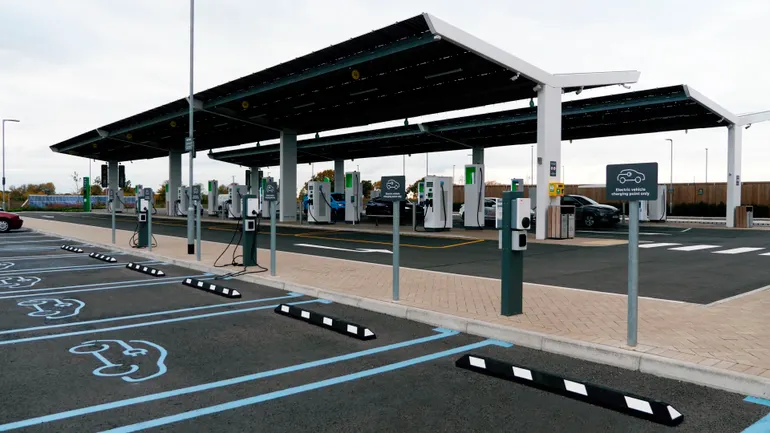
The key to achieving the United States' net-zero emissions goal lies in the transition to transportation electrification, and the smooth progress of this process may depend on whether utility companies can develop better electric vehicle charging management strategies. Power system analysts point out that without effective management, grid reliability will face threats.
In 2022, electric vehicles accounted for less than 1% of total light-duty vehicles in the United States (according to J.D. Power data), but already represented 7% of new car sales (according to the Alliance for Automotive Innovation report on March 23). The federal government's 2030 goal—to make EVs 50% of new car sales (White House statement on March 30), supplemented by the EPA's newly proposed tailpipe emission standards—if unmanaged, the expected surge in electricity demand could jeopardize power system reliability, analysts agree.
"EV advocates support managed charging through new rate designs and utility direct load control programs that compensate customers and allow third-party participation," said Autumn Proudlove, Deputy Director of Policy and Markets at the North Carolina Clean Energy Technology Center (NCCETC). She added that managed charging "benefits EV owners, other customers, and utilities while ensuring system reliability."
Experts note that as major utilities propose time-varying rates (TVR) and new approaches to demand charges for high-capacity charging, rate design is evolving. The Lawrence Berkeley National Laboratory's July 2022 "EV Retail Rate Design 101" states that price changes in TVR can be adjusted in real time, divided by daily price periods, or triggered by extreme demand events to reflect dynamic changes in system demand.
Lon Huber, Senior Vice President of Pricing and Customer Solutions at Duke Energy, said the company has "redesigned" its TVR to "provide consistent price signals to all customers." Its "hourly pricing option" will support EV fleets and high-capacity "fast charging" while avoiding "indiscriminate demand charges" that unnecessarily increase charging costs and threaten their economic viability.
Utility rate design analysts, EV advocates, and researchers agree that more dynamic TVR is suitable for residential EV charging. However, opinions differ on how precise TVR needs to be and how to adjust demand charges for high-capacity charging to avoid hindering the deployment of critical charging infrastructure.
Time-varying rates for all customers
Proudlove of NCCETC and others monitoring state regulatory activities say most state policymakers are developing new policies and rate designs to support distributed energy resources (DER), including EVs and charging infrastructure.
Mark LeBel, Senior Associate at the Regulatory Assistance Project (RAP), believes all rate designs, including those related to transportation electrification, should align customer choices with usage patterns that minimize system costs. LeBel says new system-wide residential TVR designs can link electricity usage to system costs, avoiding "adverse impacts" on utility revenues or other customers.
LeBel notes that changes in customer load patterns, increased penetration of variable renewable energy, and customer access to smart technologies "have undermined the rationale for traditional fixed rate designs." TVR can recover utility revenues through rates while eliminating "inefficient" fixed demand charges that "overcharge for off-peak usage and undercharge for peak usage."
A series of papers released by the Energy Systems Integration Group (ESIG) in January point out that with enabling technologies, customers on TVR can shift usage from expensive peak periods, thereby increasing power system flexibility, reducing customer costs, and supporting economy-wide electrification. However, Travis Kavulla, Vice President of Regulatory Affairs at NRG Energy and former Chairman of the Montana Public Utility Commission and former President of the National Association of Regulatory Utility Commissioners, reports that as of 2019, only 1.7% of residential customers were enrolled in TVR.
LeBel of RAP and others agree: "As a side benefit, EVs can charge during lower-cost TVR periods," making transportation electrification more cost-effective than gasoline vehicles and promoting broader adoption of transportation electrification.

EV rate design
According to a February 2022 report by Fortune Business Insights, the U.S. EV market value is projected to grow from $28.24 billion in 2021 to $137.43 billion by 2028. McKinsey & Company's April 2022 analysis adds that charging infrastructure deployment may need to grow 20-fold. The NCCETC's February 2023 national EV policy update report notes that to manage associated electricity demand, regulators are approving new TVR designs for EVs.
"TVR is a passive managed charging option for customers. Utility direct load control of chargers is an active managed charging option, which utilities prefer because it gives them clearer visibility into load," said Proudlove of NCCETC. She added that to give customers control, some utilities are testing TVR combined with critical peak pricing to increase incentives to reduce charging during rare extreme demand events. To use TVR effectively, customers may need smart chargers, programmable vehicle telematics systems, or separate meters that are not yet widely available.
Proudlove mentioned that a less common alternative is subscription rates, where utilities offer "virtually unlimited off-peak charging" at a simple, fixed, low rate in exchange for greater direct control over charging. All these options have been proposed to regulators, and some have been approved with support from EV advocates. But she says regulators, utilities, and EV advocates are closely watching the still-limited conclusive results.
The NCCETC reports that in 2022, 31 states considered new EV rate structures incorporating TVR. In California, which has 39% of all EVs in the U.S., three major investor-owned utilities—Pacific Gas & Electric (PG&E), Southern California Edison (SCE), and San Diego Gas & Electric (SDG&E)—already offer multiple EV-specific TVR programs.
Driver acceptance may be emerging. PG&E spokesperson Paul Doherty reports that as of November 2022, a growing number of PG&E customers are using its default EV TVR and charging during off-peak hours. SCE spokesperson Paul Griffo says an estimated 80,000 customers use its TOU-D-Prime TVR, saving a median of $216 annually by reducing summer peak demand by "20.4% (0.47 kW)," with enrollment growing at "4% to 5% per month."
Other states are in the pilot or regulatory proposal stage. Avangrid New York's OptimizEV project is piloting TVR products, while Massachusetts House Bill 5060 (enacted August 2022) requires the state's investor-owned utilities to submit residential EV TVR proposals by October 31, 2025.
In 2022, EV TVR were approved for El Paso Electric, Xcel Energy Colorado, and Arizona Public Service, with similar proposals from Tucson Electric Power and UNS Electric, two other Arizona investor-owned utilities, under review. After a December 2021 Guidehouse evaluation showed positive customer response to Evergy's Missouri TVR pilot, state regulators ordered the utility to migrate all customers to a suite of TVR options by the end of 2023.
According to NCCETC, Puerto Rico's investor-owned utility PREPA's multi-part TVR and subscription program was approved in January 2023. Austin Energy recently added a $0.21/minute flat rate for more than 25 fast chargers in the city, joining its existing subscription program (which offers unlimited charging at more than 1,000 Level 2 public chargers for $4.17/month). An Xcel Energy proposal would make its pilot subscription rate permanent.
Duke Energy's rate design roadmap, developed in March 2022 at the commission's request, describes plans for TVR, subscription rates, and hourly pricing proposals. Duke Energy's Huber says hourly prices "rise when system capacity is constrained," ensuring EV owners pay more for charging during high-demand periods and protecting other customers from cross-subsidies. He adds that judicious use of hourly pricing can "significantly reduce average monthly bills" for high-capacity EV charging stations.
In this way, Duke Energy's proposal also offers a new approach to the demand charge issue for high-capacity charging stations that many regulators, utilities, and transportation electrification advocates are grappling with.

The demand charge barrier
According to the May 2022 white paper by the Alliance for Transportation Electrification (ATE), any demand charge is a billing cycle fee in dollars per kilowatt assessed on a customer's highest 15-minute, 30-minute, or 60-minute usage. Low-utilization charging stations need to recover high demand charges by raising the per-kilowatt-hour rate charged to all customers, the white paper adds.
"A large retail store might have a peak load of about 500 kW, but a fast charging station with only 16 plugs and low utilization could hit 1.8 MW in one hour while being at zero kW 80% of the rest of the time," said Jim Lazar, a researcher at the Energy Democracy Institute at Pace University's Energy and Climate Center. Lazar added that utilities recover costs through rates, "and to serve that occasional 1.8 MW peak, the utility's costs could be substantial."
ATE notes that high per-kilowatt-hour charging rates set by charging stations to cover utility demand charges could limit their economic viability, potentially discouraging EV service providers from deploying "much-needed public charging stations." ATE concludes that a lack of demand charge innovation that supports both EV service providers and utility cost recovery could "negatively impact EV adoption levels."
Among approaches to addressing the demand charge issue, "the dominant solution right now is a waiver for a set number of years or a sliding rate tied to utilization," said Proudlove of NCCETC. "When utilization is high enough, the demand charge can be reimposed or phased back in without significantly raising the per-kilowatt-hour rate," she said.
In December 2022, Massachusetts regulators approved utilization-based ten-year demand charge adjustments for Eversource, National Grid, and Unitil. In April 2022, New Hampshire regulators ordered Unitil and Liberty Utilities to implement temporary demand charge waivers to increase utilization. In 2022, Georgia Power proposed a sliding-scale demand charge until utilization reaches 15%; Entergy Texas proposed a demand charge adjustment expiring when monthly utilization reaches 15%. In January 2023, New York regulators approved an adjustment with demand charge reductions at 10%, 15%, and 20% utilization levels.

A better approach
LeBel of RAP argues that demand charge waivers and sliding rates are only temporary solutions, and most cost recovery should be achieved through TVR. A 2020 RAP paper co-authored by LeBel notes that in today's power system with high shares of variable generation and load, most system peak demand is met by increasing generation or curtailing load, rather than creating new infrastructure costs.
Proudlove says the demand charge adjustment proposals utilities are exploring include TVR, fixed charges, "energy charges with no demand charge and no intention to reinstate one." This eliminates "single-interval" charges and simplifies customer bills, "but sends price signals to customers to shift charging times to reduce total system peak demand, thereby recovering service costs," she adds.
ATE agrees that such rates (similar to the concept proposed by Duke Energy) "can reflect the cost of service without directly assessing a demand charge." Duke Energy's Huber says its pilot will offer "dynamic hourly energy rates and a small demand charge to recover the system costs of serving new transportation electrification load." Hourly prices will reflect system costs: higher during rare system demand spikes and lower at other times.
"If charging stations can reduce charging during the 100 to 200 hours per year of demand and price spikes, the utility can avoid new system investments," Huber said. "Our calculations show customers could save up to 25% to 45% compared to traditional three-part rate structures," he added, with only "a slight shift in charging times and a little inconvenience."
EV advocates and analysts say that given EV adoption is still relatively low and fast charging deployment is just beginning, the prudent regulatory process from proposal to pilot to full rollout is currently working. But they also agree that rate design innovation cannot wait too long. "It is well known that change often happens slower than expected, but once it happens, it can be faster than expected," cautioned Lazar of the Energy Democracy Institute.